

Year 12 Cultural Outing
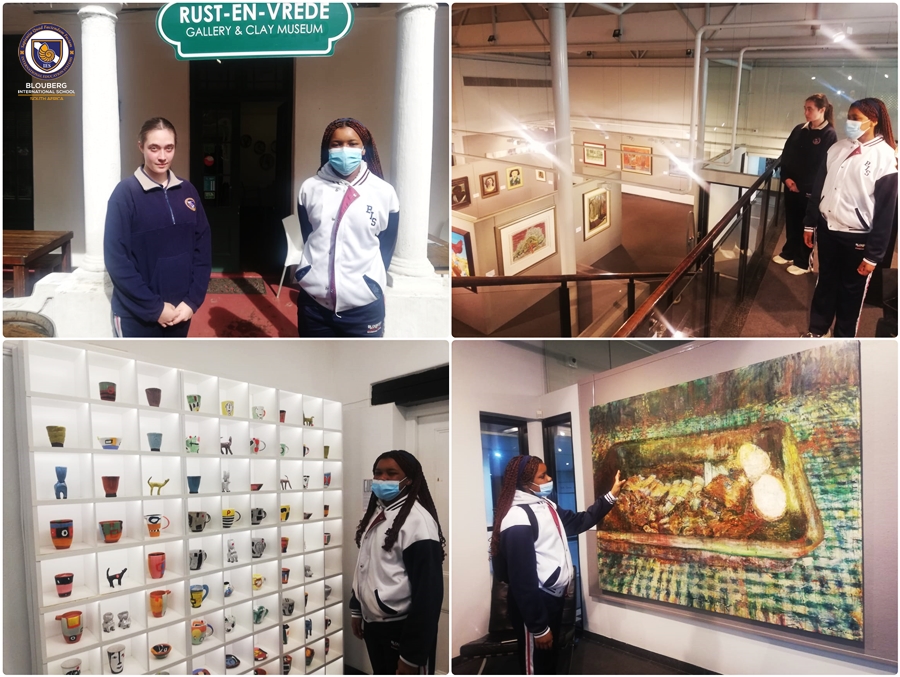
On Friday, 12 August, the Year 12 Art students braced the winter cold and headed out to explore the cultural aspects and art galleries in the Tygerberg area.
We visited the Art.b gallery at the Bellville Library Centre, the Sanlam Art Collection at the headquarters of Sanlam, and a collection of international ceramics and mosaic artworks.
“Uncle Clive” drove us around in a BIS minibus and returned us safe and sound to BIS.
Art.B gallery
https://www.artb.co.za/vuleka-2/
Art.b, the Arts Association of Bellville, is an innovative, community–orientated organisation, sensitive to new ideas and supportive of established and emerging artists from all cultural backgrounds. Art.b, through its vibrant art gallery, creates a platform for and showcases visual art and artists in the Western Cape to raise public awareness of art.
The Arts Association of Bellville is the Western Cape branch of the South African National Association of Visual Art. It is a non-profit membership-based organisation open to all. The gallery is maintained and managed with the support of the City of Cape Town.
https://blog.sanlam.co.za/her-sanlam-art-gallery-bellville/
The Sanlam Art Collection came into being on 9 March 1965 when the Sanlam Board approved the acquisition of 12 paintings by well-known artists for the production of a prestige calendar in the coming year. The collection has grown considerably since and has proved to be a good investment, with the current valuation of the collection exceeding twenty times what it has cost to acquire.
The collection is seen not only in Sanlam offices but also in touring exhibitions across South Africa. Sanlam continues to acquire significant images from established and emerging artists in South Africa and this Centennial exhibition reaffirms its commitment to supporting the visual arts for generations to come.“Her… An exhibition of painting, sculpture, and printing from the Sanlam Art Collection celebrating South African Women Artists.”
Sanlam Art Gallery, Bellville 4 August – 22 October 2022
The present exhibitions in the Sanlam Art Gallery, Bellville, and Sanlam Art Lounge, Bellville celebrates the artistic talents of South African women artists from the early twentieth century to the present. The images by a diversity of women in different media allow for a multiplicity of themes to emerge pertinent to the concerns of women artists over the past century. The exhibition ranges from the capturing of mood and beauty in flowers, the domesticity of daily life and motherhood to the reflection on discrimination and violence against women.
Rust-en-Vrede Gallery, Wellington Rd, Durbanville
The well-established Rust-en-Vrede Art Gallery showcases works of art by established and emerging artists. There are three exhibition spaces at Rust-en-Vrede.
The main gallery consists of two rooms and is referred to as Salon A and Salon B. Salon C is in the entrance room, which is a more informal space used for small solo- or group exhibitions.
Gallery Hours are Monday – Friday 09:00 – 16:00 and Saturday 09:00 – 13:00. The exhibitions change monthly and are freely open to the public. Artists who wish to exhibit at Rust-en-Vrede are requested to submit work and a short proposal to Gallery Management.
The members serving on this committee are nominated at the Annual General Meeting in August. They meet monthly to assess new applicants for exhibitions with the curator.
PIET-MY-VROU MOSAIC STUDIO
27 July ’22
An exhibition of mosaics by the students of Piet-My-Vrou Mosaic Studio. Exhibition opens on Saturday 30 July 2022 at 11 am.
Riaan Vosloo
IGCSE, AS and A Level Art and Design Teacher

Read More
BIS Performs At The Baxter Theater!
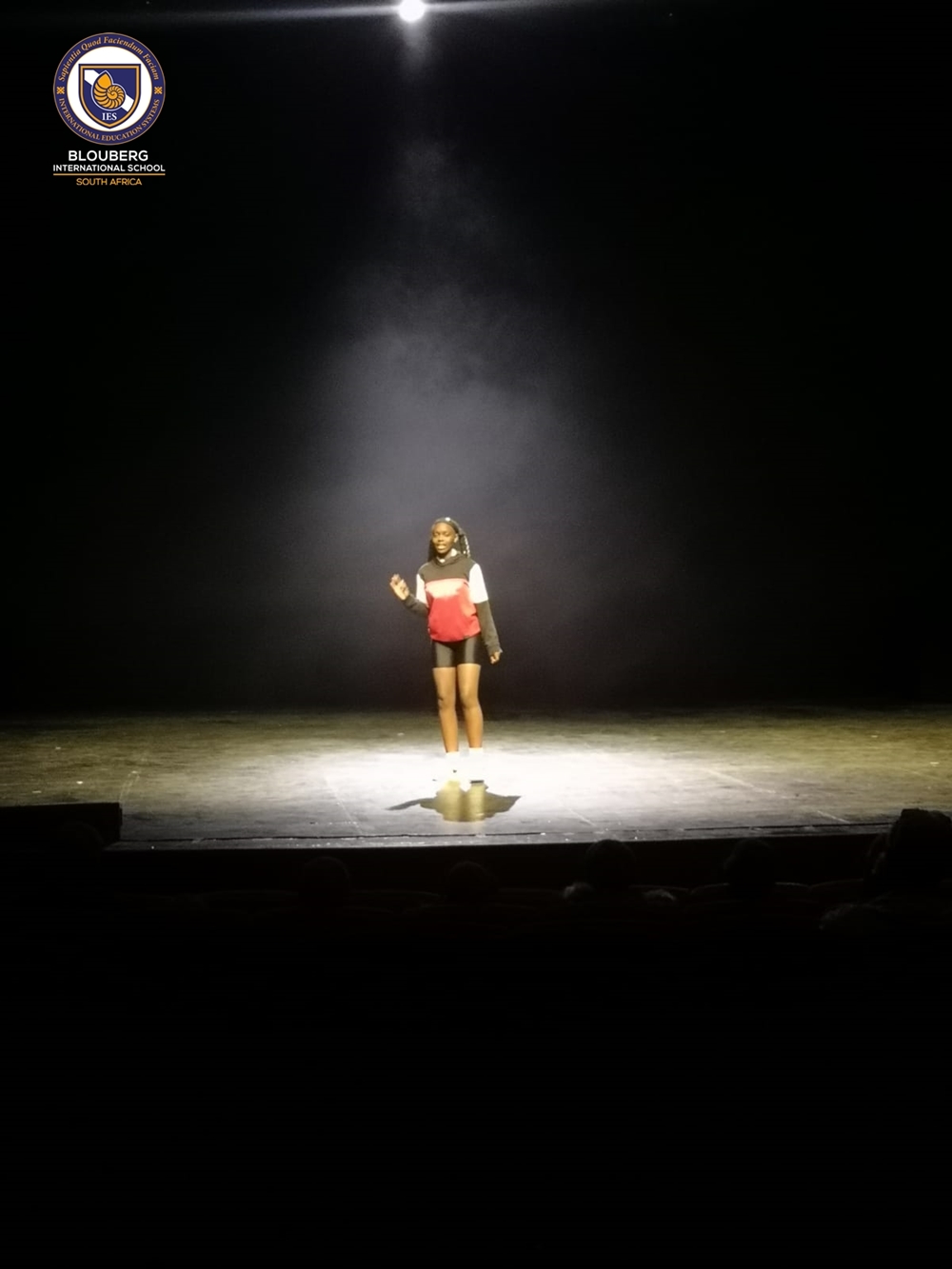
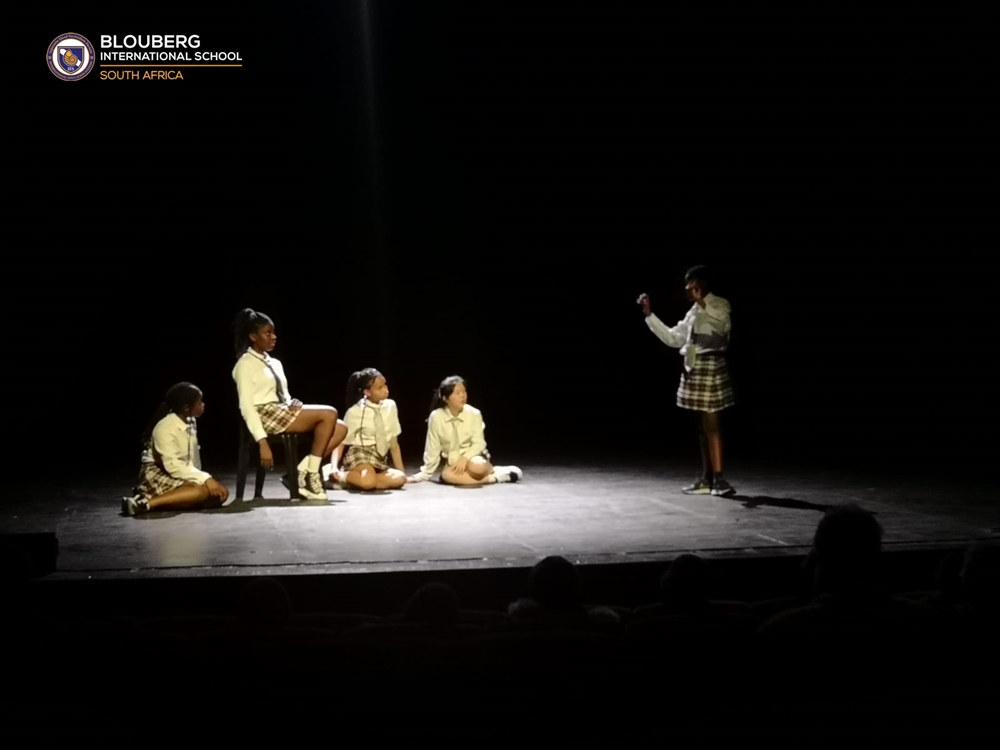
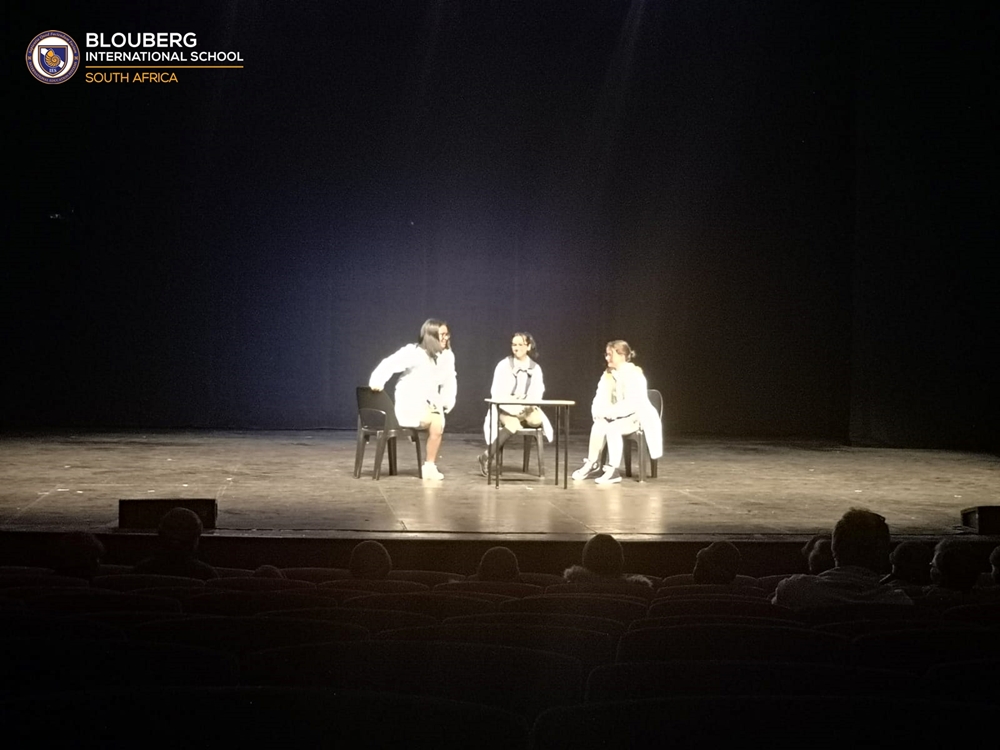
A few of our High School students had the experience of a lifetime on Wednesday, when they got perform to a very large audience on a professional theatre stage. BIS participated in the annual Shakespeare Schools Festival, which since it’s inception, the festival has become Africa’s largest Shakespeare youth drama program and has worked with over 490 schools, 9000 youth, 670 teachers across the Western Cape, Gauteng, Kwa-Zulu Natal and the Eastern Cape.
About the play:
The play is a modernised version of the “The Scottish Play” Macbeth by William Shakespeare. It is a spin off that takes place in an all-girls’ school, Dunsinane High, and instead of aspiring to be king or queen, Macbeth wants to be Headgirl. “Lady Macbeth” in this version is Bethany. The decision to modernise the play was made in order to help the students connect with the characters.
BIS took A Midsummer Night’s Dream to the Shakespeare School’s Festival in a previous year and we enjoyed it so much; that it was decided to make it an annual endeavour. This helps to allow our students the opportunity to develop their talents and passion and to perform on a professional stage. Though we were rehearsing intermittently for some time, the script change was only complete about a month ago.
I am so proud of the entire cast and crew members, many of whom were on stage in this capacity for the first time. They were extremely nervous, but did their utmost. Thank you to everyone who came to support our performance at the Baxter Theatre.
We look forward to our performances at school tonight at 18:30 and again at 19:30.
Tickets are only R40 and will be sold at the door.
High School Performing Arts and English Teacher

Read More
Welcome Back
I would like to take this opportunity to welcome you back to the beginning of Term 3. My wish is that you have relaxed, recharged, and feel ready to start the new school term. Campus bounced back this week with students returning from their vacation and new students joining the BIS family. Our students are indeed grateful to see their friends again as they prepare for their collaborative learning and captivating lessons.
We have been looking forward to what Term 3 has in store, including yesterday’s IES Sports Day, Year 10 camp, and our Macbeth production at the Baxter Theatre on August 10th.
I appreciate your positive energy and I look forward to working with you in the new term. All signs point to another incredible and productive school term.
I know each of us wants to make a difference in the lives of our students.
Parents, here is how you can support us and help your child become independent and “own” their learning:
- Be sure to check in with your child daily, about the learning tasks, activities, and assessments they are working on.
- Demonstrate a positive attitude about education to your children. What we say and do in our daily lives can help them to develop positive attitudes toward school and learning and to build confidence in themselves as learners. Showing our children that we value education and use it in our daily lives provides them with powerful models and contributes greatly to their success in school.
- In addition, by showing interest in your children’s education, parents and families can spark enthusiasm in them and lead them to a very important understanding that learning can be enjoyable as well as rewarding and is well worth the effort required.
- Encourage them to complete work to the best of their ability
In closing, I would like to share this interesting post from the “parenting team”, and I would like to add teachers to that team as well – because we are all in this together.
Challenge: Back to School
Been There, Been Through That…9 Tips for Parents of High Schoolers
https://community.today.com/parentingteam/post/been-there-been-through-that9-tips-for-parents-of-high-schoolers
We thank you once again for the consistent and unwavering support you have always shown.
Carmen de Villiers
High School Coordinator
Read More

Term 2 Reflection
We have reached the end of an action-packed semester and would like to thank all our families for your support and dedication. A heartfelt thank you to our teachers for all their hard work to provide a stimulating and constructive environment for our students.
Well done to our High School students who performed well this term in their CASS assignments and examinations – We are so proud of the progress you are making.
Our term was filled with many highlights such as our Year 11 journey, Art Auction, special outdoor and sporting events, and ending the term on a high note with the various class challenges and student wellness day. On all these occasions, we were inspired by our students’ creativity, ingenuity, and growth.
We wish all our BIS families a safe and warm winter holiday. May we continue to encourage each other and be kind to ourselves and those around us.
Carmen de Villiers
High School Coordinator
WATCH: The High School Houses Challenge Each Other During the Term 2 Wellness Day House Games: https://youtu.be/YQNbmTPuvho
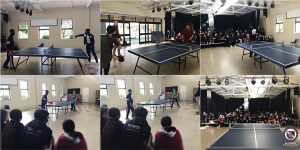

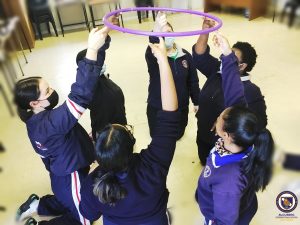
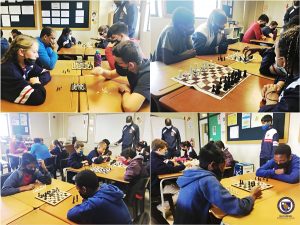
Read More
Murderous Macbeth: Paranoid Prefect
We all know and love to hate Shakespeare’s infamous ‘Macbeth’, also known as the “Scottish play”, which etches out the tragedy of an ambitious man who murders his way to the crown. Encouraged by his even ruthless wife and the predictions of three “fates”, Macbeth goes down a dark, haunting, and intriguing path to his demise.
Now, what if we take that basic plot and set it in 2022, in an all-girls school, with head prefect as the goal? The product is all the teen drama one could dream of… but make it a nightmare.
Mackenzie “Lady” Macbeth and her girlfriend, Bethany, want to rule the school. Who do they need to take down to get to the top? And how will they make it happen?
Still dark, as evil plots unfold; still haunting, as there are literal ghosts; and still intriguing, as we try to understand methods and motives: this play is bound to disturb and entertain.
Blouberg International School’s modern version of ‘Macbeth’ will take to the Baxter Theatre stage during the Shakespeare School’s Festival, on Wednesday, 10 August, and again on our school stage on Friday, 12 August.
To book click here! https://www.webtickets.co.za/v2/Event.aspx?itemid=1513749284 (Please ensure to book for one of the days our school performs, as we do not perform every day)
Come to see if they can wash the blood off their hands.
Genevieve Kerswill
High School English Teacher and Drama Coordinator
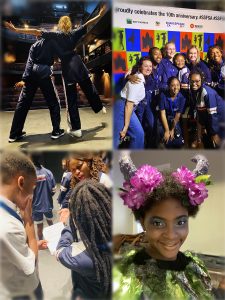
(PHOTOS BELOW: Moments on stage from our Midsummer Night’s Dream performance at the Shakespeare School’s Festival in 2020 at the Fugard Theatre)


Read More

The Original Gangster Rapper
Young, intense, fickle love; arranged marriages; civil and parental disobedience; gangster warfare; silly jokes, nasty insults and suicide… these are all themes and issues the Year 7 and 8 students will be exploring in English this term. Sounds like some of the hot topics in the “no-good” music our youth listen to these days. Shocking? Nay, Shakespeare! The tragedy of Romeo and Juliet to be specific. Throw in a convoluted love square, a plot to kidnap a kid, some fairies and a magical flower and you have the comedic A Midsummer Night’s Dream too.
Oftentimes Shakespeare’s plays are viewed as stuffy, filled with “fancy” language and are considered unrelatable for modern audiences. When one realises that the language Shakespeare used was true to how everyday man spoke at the time and that he mixed formal and informal diction and structure to represent social status (and thus level of education), with colloquial language, slang and all of the drama that continues to plague mankind to this day, it becomes clear that the only barrier that truly sets Shakespeare’s work apart from us is our translation of Old English. Overcome this and we can appreciate the brilliance of Shakespeare’s plays in our world today and perhaps also develop an understanding of how language evolves.
When questions of modernity come to the fare, I enjoy emphasising that with rhyme, wit and themes that criticise and mimic society and mankind at large, drawing out every manner of emotions in the audience, Shakespeare’s poetry and plays are comparable to modern day “gangster rap”, gut-wrenching love songs or stories and creations of fantastical worlds in which we love to lose ourselves. Let’s not forget the thousands of words and phrases that first appeared in Shakespearean writings and are still made use of today.
Is Shakespeare irrelevant? Never! Shakespeare not only gives us a view into Elizabethan era society but forces into focus how much humanity has progressed in some ways and remained unchanged in others. The human condition seems to be eternal. When I asked students if they would allow their parents to choose their love interests, for example, they were in strong opposition to the idea and would rather choose to respectfully decline or flee – as epitomised in the characters of Juliet and Hermia. They seemed relieved at the fact that the patriarchy of the 16th and 17th century no longer holds as much weight in their world as it still does in many countries across the globe. They were also shocked and amused by how grungy Shakespeare can be in his diction chosen for many a comedic character. They expect that kind of language from their rap musician interests and controversial comedians or a movie their parents might be opposed to them watching. But from “Mr Fancy Pants” himself? Lo, how we misinterpret thee and thou for anything other than a casual ‘you’.
Considering topics of woe and misfortune, murder and the use of mind-altering magic as well as lingo one’s grandmother would threaten with soap, perhaps we should take Shakespeare out of the curriculum? How dare we putrefy young minds with 400-year-old madness? Surely however, if art imitates life, everything portrayed in Shakespearean plays is out there anyway and we cannot shelter our youth from what is thrown at them during a news report, in the lyrics of popular songs and a favoured game, television show or film? Indeed, man has not progressed far beyond many of these scourges since the bubonic plague hit London in the 15-1600’s. Shakespeare is thus certainly still relevant. Why else do we learn about history? Why else to we try to change governmental policies that seem to have been implemented in the stone ages and fight for our ever-changing human rights? Why do we learn to communicate with all manner of man, to explore and to grow in knowledge towards changed minds and hearts? In my opinion, what we can learn about ourselves from the works of a long-dead playwright, is far more beneficial than the darkness of humanity he reveals is scarring.
I asked my students about their opinions of Shakespeare this week and whether or not they think it should be kept in the yearly curriculum. There was definitely some strong opposition, with Year 8 students describing Shakespeare as dramatic, tedious, but entertaining, and acknowledgement that when one doesn’t understand the original text it is like reading Arabic. However, one student in Year 7B stated, with a chorus of agreement from his classmates, “I thought it was going to be boring, but now I am entertained,” and another chimed in, “The more I read, the more I want to read.” A few in 7A are intrigued and feel that Romeo and Juliet contains some of the best pick-up lines they have heard and are keeping note so that they might use them in future. Some of the Year 9 students who have studied a few of Shakespeare’s plays describe Shakespeare’s work as hallucinogenic, dark, tragic and, “Hectic! PG!”
Whatever one’s personal opinion on the matter of Shakespeare in the curriculum, along with his “low-down”, dark talk and tales, Shakespeare offers us gripping storylines, undeniably beautiful poetry, truer words than anyone else knows how to express, laughs and advice we would do well to heed.
“These violent delights have violent ends
And in their triumph die, like fire and powder
Which, as they kiss, consume.”“Wisely and slow; they stumble that run fast.”
Warnings by Friar Lawrence in Romeo and Juliet
“Do not swear by the moon, for she changes constantly. Then your love would also change.”
Juliet to Romeo – hints at the fickle nature of a young man’s love, epitomised by Romeo’s instantaneous switch from obsession over Roseline to Juliet.
“What’s in a name? That which we call a rose
By any other name would smell as sweet.”
Juliet, pondering the relevance of Romeo’s surname and standing as a Montague, her family’s (the Capulets’) sworn enemy.
“O serpent heart hid with a flowering face!
Did ever a dragon keep so fair a cave?
Beautiful tyrant, fiend angelical, dove feather raven, wolvish-ravening lamb! Despised substance of devinest show, just opposite to what thou justly seemest – A dammed saint, an honourable villain!”
Juliet describing Romeo after she finds out he has killed her cousin in a murderous, vengeful rage. A commentary on how appearances and behaviour can stand in contrast to one another and how despair can lead one to act out of character. This also displays Shakespeare’s love of oxymorons – contrast through contradiction.
A few special quotes from A Midsummer Night’s Dream:
“The course of true love never did run smooth.”
“Love looks not with the eyes, but with the mind,
And therefore is winged Cupid painted blind.”“Lord, what fools these mortals be!”
“And yet, to say the truth, reason and love keep little company together nowadays.”
A few great TEDx talks for those who love Shakespeare but not Hip Hop or visa-versa:
- Shakespeare was the First Gangster Hip-Hop Artist by Doug Rappaport – https://www.youtube.com/watch?v=iIojIWLnMiU
- ·Hip-Hop & Shakespeare? by Akala at TEDxAldeburgh https://www.youtube.com/watch?v=DSbtkLA3GrY
High School English Teacher

Lockdown Learning
What Shakespeare can teach us about surviving online learning.
What do we English teachers do when times are tough? We look to the Bard of course! Who better to guide us through the online educational space than a writer who has been dead for over 400 years! Now before you scoff “nonsense” over the rim of your coffee mug and scroll to the next page, let’s consider this in a little more depth. The transition to online learning has been challenging for students and teachers alike and we have all been plagued by fears and doubts. First Language English is a subject which you may consider one of the easier subjects to study online and perhaps you have a point. I can email you a poem- you can read it- you can write me an essay about it. Bob’s your uncle, done and dusted. Bring on the next one… Well, not quite.
Why does an author write a book? Obviously they want people to read it, but more than that, they want people to talk about it; it’s the hushed conversation in smoky cafes, the heated discussions over a plate of Thai chicken niblets at an annual Book Club meeting and the dog-eared, coffee stained pages of a favourite book passed from parent to child. Literature provokes dialogue and debate and as I always say to my students “It’s okay to hate the story you’ve just read, but you must be able to tell me why”. Stories, poems, plays- they are meant to be read and shared and isn’t it a truism that it is just as satisfying to discuss something you love as something you hate?
This is why I want to be back in my classroom! Not just for my view of the mountain, but for the interaction; the back and forth across the classroom, the heated opinions and different perspectives which mingle and lap the edges of the room like a gentle wave on a summer’s day.
Simply put, it’s a lot more difficult to discuss a work of literature isolated from each other as we currently are. You can read the play yourself, sure, but where’s the fun in that? A play isn’t meant to be performed by one person, now is it? My belabored point is that teaching First Language English online is a challenge and no Zoom meeting or Google Hangout Meet can replicate the wonderful disorder of a good class discussion.
Back to my original point. So, what do we do when we feel the pressure, the stalking fear and self-doubt that comes with being chucked in the deep end of the pool and having to paddle like a crazed duck to stay afloat? To whom do we turn when the challenges of online learning become all too real? Why, to Shakespeare of course! As usual, our dear Bard has a few life lessons up his sleeve to help us cope.
- “Our doubts are traitors, and make us lose the good we oft might win, by fearing to attempt.” We have all suffered the pangs of fear and self-doubt in navigating online learning and adapting to different methods of teaching. We should not doubt our abilities, for nothing ventured is nothing gained, and I am fairly sure our students are prey to the very same emotions which trouble us. We are capable of a lot more than we think- from teachers, to students and parents and self-doubt is the enemy of success.
- “Give every man thy ear, but few thy voice.” Learn to listen. Perhaps the most valuable exercise I have done during online learning is to have my students to talk to me, rather than I to them. “Tell me the truth”, I say to them. “How is it really going?” I have spent many minutes at the beginning of online sessions just listening… listening to the complaints, the fears, the excuses and you know what? I really have learnt a lot. I am learning what is working and what isn’t. Online learning is a collaborative process and if both sides are honest about their expectations and progress, then the game is half won.
- “Better three hours too soon than a minute too late.” Don’t be late. Shall we leave it at that and move on?
- “Pleasure and action make the hours seem short.” Keep busy and keep your mind active. I always imagined myself as the perfect lounge lizard, but to be honest, if I wasn’t working, I would’ve gone mad on Day 3 (Day 4 if Netflix released Outlander season 4). It’s important to keep ourselves busy and I don’t just mean with hours of admin and slog in front of the computer; I mean busy with activities which stimulate the mind. This goes for our students as well- research tasks which require them to think and engage with material. I enjoy setting argumentative and discursive topics for my students; topics which require them to have a good think and do a bit of research to support their opinions. They had to write a magazine article on the topic of cosmetic surgery and boy, the opinions flooded the room like bees after Pooh’s spilt honey pot. But they were engaged, I can promise you that.
- “The miserable have no other medicine, but only hope.” I’m sure we’ve all felt the cold tickling of misery at least once during lockdown but on the bright side, as the saying goes, there’s no way but up from here. Shakespeare reminds us that the doldrums only increase our focus on the horizon and the calm flats which lie ahead. Let us remain positive and instill this positivity in the students. Complaining may be temporarily cathartic but does little good. We are learning new skills, finding hidden talents and drawing on resources we never knew we had. It’s an adventure and like all good tales, it starts out filled with peril and looming disaster, but by the end we’re all safe at home with a nice cup of tea. Or more aptly for our context, by the end we’re all in each other’s homes sharing a nice pot of tea.
Take the Bard’s words to heart. Enjoy a good book and don’t try and argue with me that Shakespeare is no longer relevant! Stay safe everyone.
Alice Pryor
High School English Language and Literature Teacher

An amazing article compiled by Catherine Fortuin (Year 8) while using the e-learning systems from Blouberg International School.