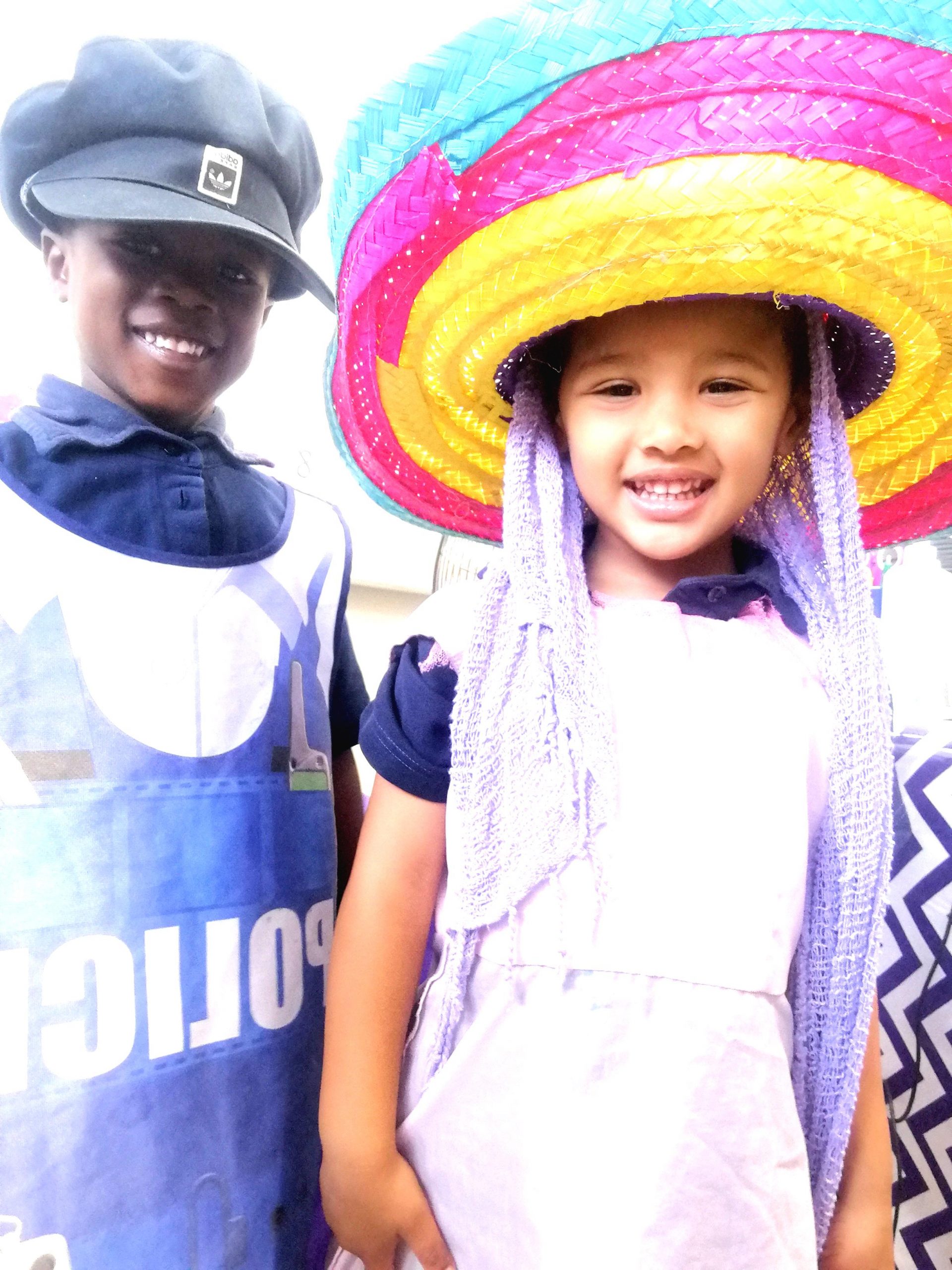
The importance of play – Pre-Reception Term 1 2019
“Play is nature’s means of ensuring that young mammals, including young human beings, acquire the skills that they need to acquire to develop successfully into adulthood”
– Dr Peter Gray
As I observe my Pre-Reception class and reflect over the first term, I can’t believe how quickly the time has gone by and how much they have already developed. “Time flies when you are having fun!” The students have settled into the class routine beautifully and for some of them it is their first time at school.
Each week they have learnt about different themes, identifying numbers and sounds, number and letter formation, pencil control, shapes, colours, done activities to strengthen their fine motor skills, complete patterns, the importance of sharing and taking turns to name only a few of the things.
As I watch and interact with my students, it strikes me that people don’t realize the importance of play and what they actually learn through play. During play children are thinking, problem solving, developing memory, planning, investigating, developing language skills, concentrating and learning many more skills… Play is healthy for children, it reduces stress and anxiety by providing an outlet. Play is the medium through which children explore and experience their world around them. It’s how they learn! To a child, playing and working or learning are the same thing.
I noticed the children in my class engaging in various types of play throughout the day:
Fantasy or Dramatic Play also known as pretend play or make – believe play which involves “acting out” ideas and role playing activities.
Sensory play involves stimulating the senses, tastes, textures, smells, colours, shapes and movements.
Investigative stage of play is when a child wants to see what happens when materials are manipulated in a certain way.
Competitive Play refers to games with rules that are more structured and may involve more than one player. My students love to play Hide and seek as well as Duck duck goose.
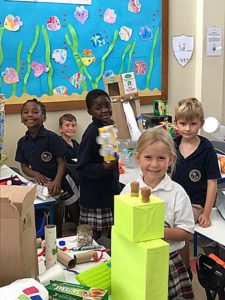
Constructive Play involves creating things and manipulating objects to make something. Some of the students really enjoy playing with the wooden blocks and building the most amazing constructions.
Physical Play refers to play that is purely physical, such as climbing a jungle gym, skipping etc.
Creative Play is about creating art using paint, crayons, cutting and pasting etc to express oneself.
Here are some tips how parents can support their child through play in the holidays:
-Allow enough time for play indoors and outdoors every day.
-Provide a safe environment.
-Play with your child and verbalise what they are doing and ask them questions to promote language development and problem solving.
-Allow your child to explore and get dirty during play.
-Provide stimulating toys and equipment.
-Encourage freedom of choice and do not interfere in the game.
-Provide clothes and accessories for dress-up play.
-Focus on the enjoyment of the game and not only on winning.
-Focus on games that teach mathematical and early reading skills.
-Play is not just good for your child but it’s good for parents too. Similarly to children, play helps parents relieve stress, mend and strengthen relationships and keeps everyone happy.
So the next time your children ask you to play with them, it’s not just good for them it’s good for YOU too!
Cindy Nunan
Pre-Reception Teacher
De Beers English Olympiad 2019
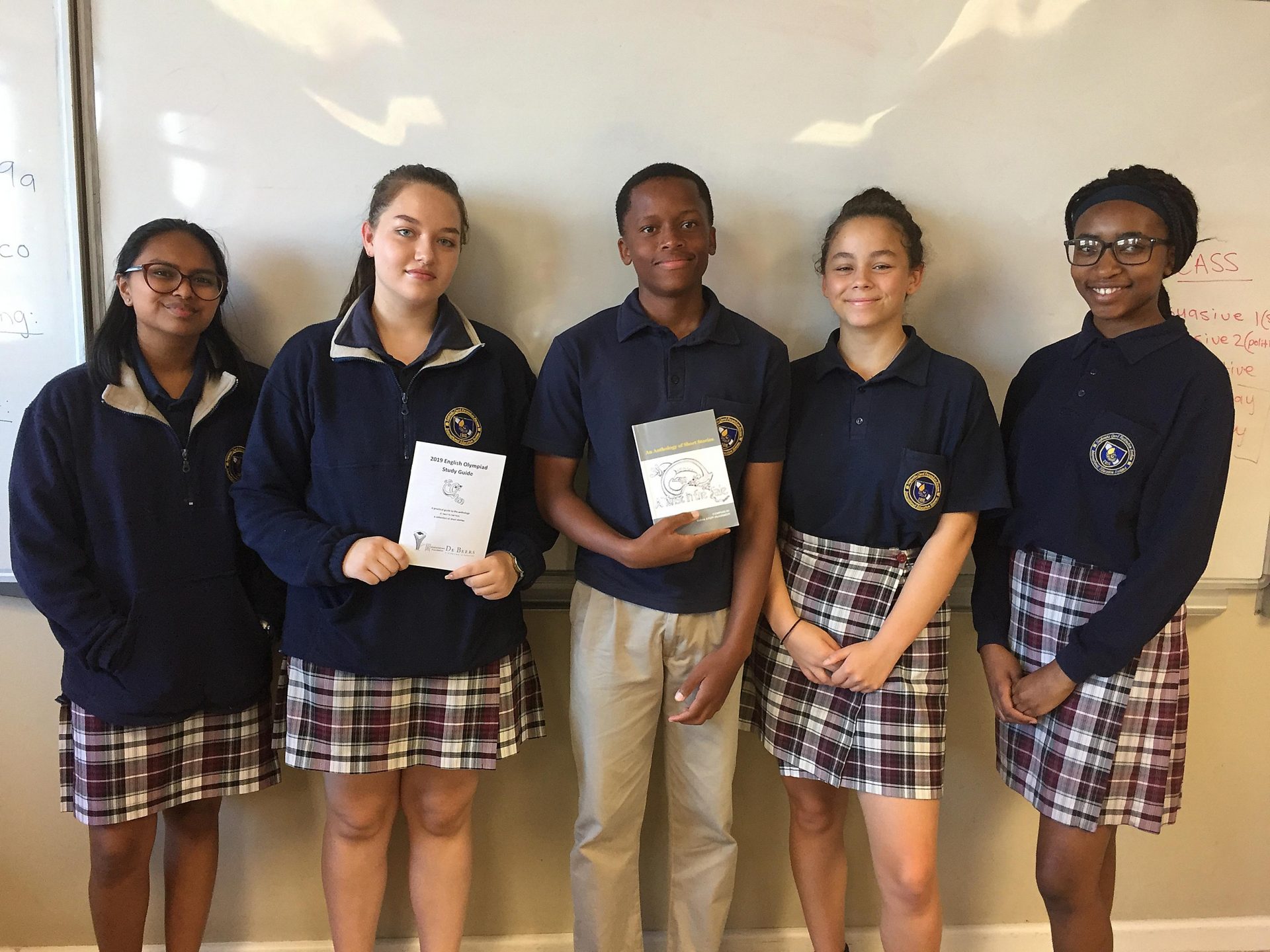
On Tuesday the 5th of March five of our senior students competed in the prestigious De Beers English Olympiad.
The De Beers English Olympiad is an English competition that draws over 8000 entries each year from around South Africa and its neighbouring countries. The competition is organized jointly by the Grahamstown Foundation and the South African Council for English Education (SACEE). The competition began as a small project in 1976 when Dr Malcolm Venter, a member of the Eastern Cape branch committee of SACEE was asked to organise an event locally. The first competition attracted 119 entries and the winner received a prize of R50. Today, by comparison, the top 3 candidates receive substantial cash prizes of R33 000 (1st place); R30 000 (2nd place); R27 000 (3rd place) broadening their opportunities for possible further study or travel.
The competition seeks to enrich learners, encouraging them to explore beyond the scope of the school syllabus. It encourages critical thinking and creative writing, promoting the study of English amongst first and second English Language speakers and actively increase the participation of candidates from previously disadvantaged schools.
The De Beers English Olympiad is distinctive in that, unlike other Olympiads, it requires learners to study a prescribed text, not found within the school syllabus. 2019 saw the students study short stories, collated under the title ‘A Twist in the Tale’. Each year a different genre is studied, and a new anthology and theme compiled by SACEE. The examination is then based on this theme and anthology. On receiving the prescribed material, we set up study groups to analyse the stories and our intimate group sessions allowed us to examine the texts on a level not always possible in the structured classroom environment. The competition also gives students the opportunity to work with other students in different grades; students from years 10-12 may enter the competition and watching students, who wouldn’t normally interact in a classroom setting, quibbling over different interpretations of a text was simply wonderful.
In ‘Wings for Bulbie’ (Patrick Waldo Davids) we read of a tortured but brilliant soul, a maths teacher hounded and ostracized by a community who cannot, and will not, understand him. ‘The Luncheon’ (Somerset Maughan) sees a young writer at the mercy of the most trying lunch companion imaginable. In ‘The Suitcase’ (Es’kia Mphahlele) a young man, down on his luck, takes a chance and claims a suitcase left on the bus he is travelling in- with disastrous consequences. Many of the stories had a distinctive South African flavour but all of them were honest reflections of human nature and proved to us the timelessness of certain themes and stories.
A massive congratulations to the students who competed on Tuesday! The examination was three hours long, plus half an hour of reading time. Entering into this competition is a commitment not taken lightly and I am proud to say that all the students displayed the effort and determination necessary to stand themselves in good stead.
I encourage more students to participate next year as this competition engenders a deeper appreciation of literature by providing insight into human nature and experience. It also offers students the opportunity to bond, not as classmates or students in the same school, but as students of literature, as lovers of stories.
Alice Pryor
High School English Department Head

Year 6 Leadership Camp 2019
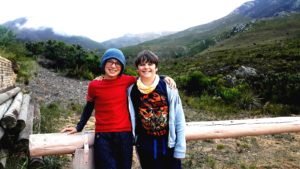
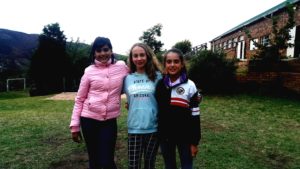
Last week, the Year 6’s traveled to the beautiful valleys of Franschoek where they forged many valuable memories at Big Oak Adventures.
Jumping into the river, climbing the mountains, and playing some intense dodge ball were just some of the activities the Year 6’s were excited to try. They put their fire-making skills as well as their “braai-ing” talents to the test for some delicious burgers. Another great activity taught them how to guide each other while one of them was blindfolded.
It is evident that many valuable leadership skills were acquired in the misty mountain camp.
We would like to thank everyone at Big Oak Adventure Camp for making our experience such a memorable one.
Written by:
Marisa Esterhuizen
Year 6 Teacher


Imagining robots – Key Stage 1
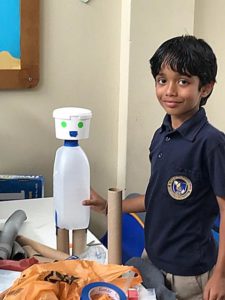
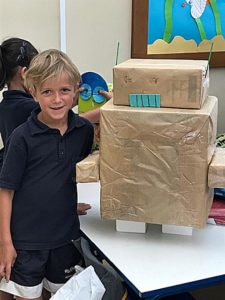
In literacy the Year 1 students have been studying stories by the author John Prater. These stories have been about the characters, Bear Hedgehog and Dragon. The Story “What can we make?” was about Bear and Hedgehog making a robot.
This really appealed to the students therefor in our Design and Technology lesson the students constructed their own robots. They designed these robots at home and then brought recycled material to school to build their very own robot. During the building process many of the students found that their design needed modification as materials could not join as they anticipated.
It is interesting to watch the students collaborate ideas and materials to help solve design flaws.
Ann Cordner
Year 1 Teacher

From the Principal’s Desk – 7th March 2019
Dear Parents
On Saturday the 2nd of March we had the first of three Open Days for 2019. Our SRC members welcomed prospective parents and took them on a tour of the school’s facilities. It was with pride that I placed prospective parents into the care of our SRC members; the maturity and enthusiasm they displayed whilst taking the parents around the school was the best marketing I could ask for.
Yovesh Naidoo, our current Head Boy, delivered a heart-warming speech, offering parents a glimpse into his experience of our school. I was struck, observing our students, by how well-mannered and mature they were. The caliber of students at our school is our greatest asset and I was reminded of this on Saturday. Mature, polite and well-adjusted students are a credit to their parents and their school.
Successful parenting is surely the appreciation and implementation of boundaries from a young age. As adults, I think we often take boundaries for granted, mistakenly believing that they are simple to establish and apply. As we remind our children about important boundaries as they develop, so should we be reminded of our own boundaries and their application in our daily lives. Boundaries and routine are very important from a young age; we have a great opportunity, daily, to build the foundations for our children and set the boundaries which they crave and desperately need. If we build the foundations in their young lives, they will develop into young adults who naturally exude kindness, respect, responsibility and other beautiful characteristics. The key is that it always starts with us parents.
Children need boundaries. They will push against them, fight them and push just that little bit more, but with perseverance and time will come acceptance and gratitude. Boundaries make children feel grounded and when they have routine, and know what is expected of them, it brings calm to an otherwise often chaotic world. They face daily challenges and we can assist them by making things easier through the routines we set and the boundaries we establish.
“Children raised with good boundaries learn that they are not only responsible for their lives, but also free to live their lives any way they choose, as long as they take responsibility for their choices. For the responsible adult, the sky is the limit.”
-Henry Cloud
Regards
Edna

Foundation Stage: The wheels of the bus go round & round…
During the last two weeks the Foundation Stage learnt more about Transport. Transportation is an important part of everyday life, and that is why so many students find this topic interesting. Transportation as a theme not only teaches our students about what different vehicles are and how they work, but we also use it to teach other important concepts such as safety when riding in a vehicle or walking.
We got to play with all the different types of transportation theme items such as cars, trucks and trains. Our students made different crafts, sang transportation songs, played games and listened to stories about transport. Learning through play will help students retain all the lessons in their long term memory.
Written by
Martie van Dyk
Reception Year Teacher
Read More
From the Principal’s Desk – 28th February 2019
Dear Parents
It has been a busy first term thus far and it has been lovely to hear positive feedback from parents and students and know that growth is definitely taking place.
This coming Saturday, the 2nd of March, we are having our first Open Day for 2019. The response to our marketing of this event has been incredibly positive and we are looking forward to welcoming prospective parents and students to our school. Teamwork produces positive results and I am extremely grateful to my staff, as well as some of our students, who are collaborating to promote our school on Saturday.
The Heads of the IES schools had a collaboration meeting this morning where were able to identify areas of growth in our various schools and do some benchmarking as well.
I am reminded of a quote which has always inspired me:
“Growth is never by mere chance; it is the result of forces working together.”
-Author unknown
As mentioned in my newsletter last week, construction of the cricket pitch commenced this week and the progress is satisfying. Unfortunately, however, due to climate and weather predictions, we have had to push back the completion date for the project. The cement is going to take longer to set than first anticipated but I am certain the wait will be well worth the end result. During the upcoming March school holidays, construction will start on the gravel parking area below the library. This will ensure that, come winter and rainy days, we all have a safe and accessible place to park.
I hope you all enjoy some wonderful family time this weekend.
Kind regards
Edna

Enquiring Minds – AS Level Biology
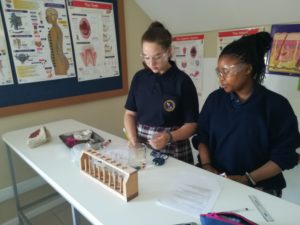
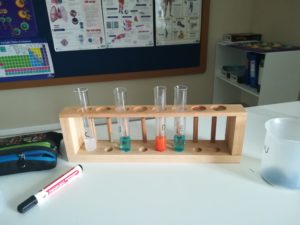
The Year 11 Biology students did their first AS-practical on biological molecules for the year. During the practical they were presented with five solutions containing different concentrations of starch and sugar. They had to use Iodine solution, Benedict’s reagent and Hydrochloric acid to determine what the contents of each solution was. The results presented an array of different colour changes that provided great excitement to the students.
This is an important first step towards preparing the students for their AS practical exam at the end of Year 12. The experience they gain by handling equipment, planning an investigation and executing the plan, will form a foundation on which to build enquiring minds.
“The important thing is not to stop questioning, not to stop research”
– Albert Einstein
Marlene Feltoe
High School Biology Teacher



Year 6 Monitors 2019
Our Year 6 monitor programme aims to develop leadership skills in our students. We believe that every student has innate qualities and can build skills that they could use to help serve our school and community in some way. Monitors help the students and teachers during break times and help monitor the classes at line up time. In addition to this, there are different portfolios that the monitors are responsible for.
Some of the other roles and duties of our monitors include:
- Assembly and Library Monitors: Set up the hall for assemblies and help Mrs M in the library.
- Recycling Monitors: Collect recycling from the classrooms every week.
- Social Responsibility Monitors: Promote social responsibility in the school by visiting the different classes and talking about important issues. This term the Social Responsibility Monitors have been explaining the importance of recycling and teaching the children what we can and can’t recycle in our paper bins.
- Journalist Monitors: Write articles about some exciting things happening at school.
Below is one of the articles our Journalist Monitors wrote about our Leadership inting.
Cool To Be Me – Year 6 Leadership Inting
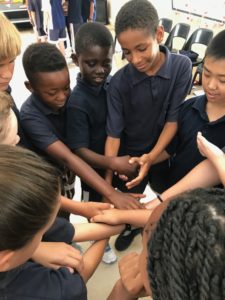
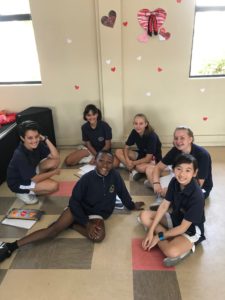
On Friday the 22nd of February Y6ME and Y6AH gathered in the hall and participated in the Cool To Be Me inting.The grade 6s learned that it is okay to be ourselves and ignore judgmental words. We were taught to use great qualities such as:
Be a good role model.
Use your role to help one another.
Do no abuse the responsibility of being a monitor.
Leaders are kind, fair and helpful.
The two grade 6 classes participated in multiple different activities on the day. Each activity taught us how to use our strengths to become better leaders in the school. We finished the inting off by creating a toolbox of our personal leadership qualities.
Written by: Ben Van der Westhuizen, Jens Buchwald, Patrick Kessel, Linamandla Moyo and Chloe Ralph
“Every individual is intelligent in a different way. Understanding how we are intelligent allows us to identify when and where we can lead.”
– Quoted from the Cool to be me Facebook page. https://www.facebook.com/cooltobemeSA/
Marisa Esterhuizen
Year 6 Teacher
https://www.facebook.com/IES.Blouberg/posts/2323620484337070
Year 2 goes to Madagascar
The Year 2’s are learning about Madagascar in Geography. The Avenue of Baobabs, ring-tailed lemurs, tomato frogs, vanilla pods, and sapphires are just a few of the things they have discovered so far.
They completed a research project where they each exhibited one interesting fact about Madagascar with a picture included. We are blown away with their contributions.
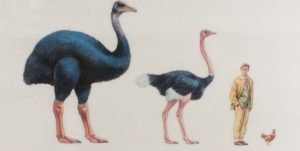
Nivad Manouchehri told the class about the Elephant Bird which is much larger than an Ostrich but unfortunately extinct.
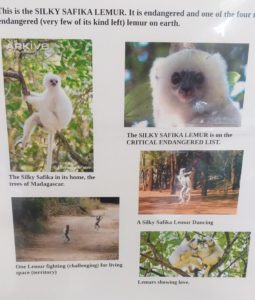
Joshua Smith brought a poster about the Silky Safika Lemur which is as tall as a two-year-old!
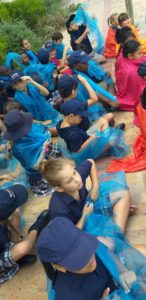
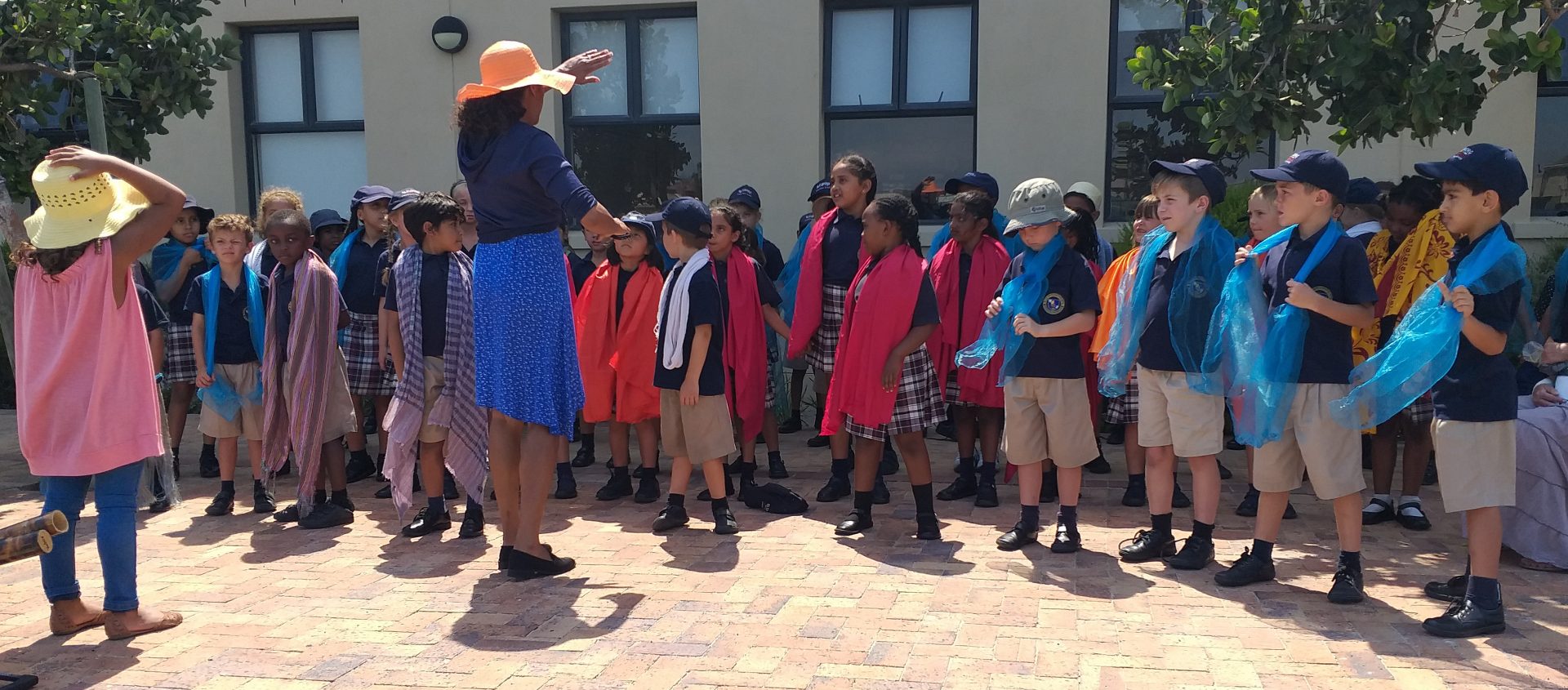
Aunty Nini came for a visit on Friday, 22nd February to tell us all about Madagascar. ‘Salomo’ is how you say ‘hello’ in Madagasy. She taught the students a Madagasy dance where they waved a “lamba” (a special scarf) to the music. We even learned how to count in Madagasy.
The Year 2’s have really relished in their adventures in learning about the fourth largest island in the world!
Gillian Baker
Year 2 Teacher