
The Importance Of Art In A Child’s Development
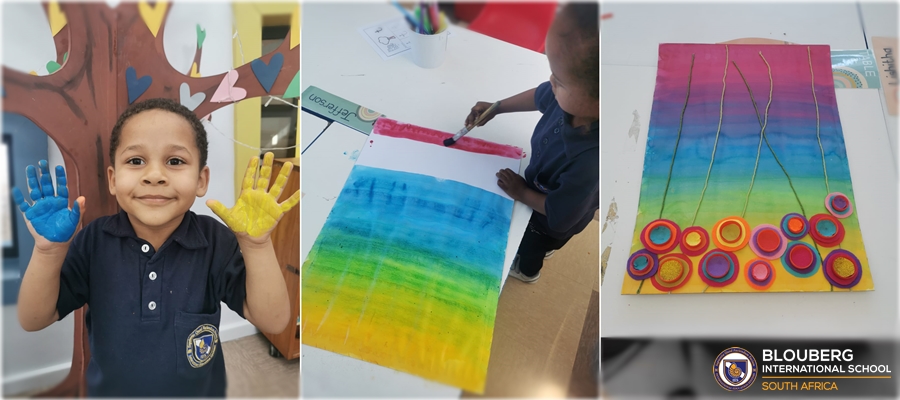
There is an overwhelming excitement and enthusiasm throughout the School as the students are busy creating the most amazing works of Art for the upcoming Art Auction on Tuesday, 26 April from 5:30pm.
It is wonderful to see the concentration on the students faces and the joyful expressions of art explored!
Creating art expands a child’s ability to interact with the world around them and provides a new set of skills for self – expression. Not only does art help to develop the right side of the brain, but it also cultivates important skills that benefit a child’s development.
SKILLS CHILDREN DEVELOP THROUGH ART ACTIVITIES:
- Life skills
- Communication skills
- Problem – solving skills
- Social & Emotional skills
- Fine Motor skills
- Self – expression & creativity
It is important, however, to separate “talent’ from ‘creativity” – a child does not have to create a masterpiece to have a meaningful artistic experience. Art is a process not just a product. It is the process of creating – exploring, discovering and experimenting – that is important and adds the greatest value. Through self – expression and creativity, a child’s skills will develop naturally. Art matters the same way language matters. It is a fundamental component of what makes us uniquely human.
Hope to see you all at our Art Auction!
Cindy Nunan
Pre-Reception Teacher

Read More

Healthy Eating
Going forward into a new term I encourage parents and students to consider adopting healthy eating habits throughout their day. In the Junior campus we have incorporated a robot system which gives the children a visual aid of which foods are a healthier choice.
The red light is used for foods which should be avoided in school lunches. “Red light” foods include items such as sweets, fizzy drinks, pastries, chocolates, etc.
The orange light is used for foods which can be incorporated occasionally in school lunches. “Orange light” foods include white grains (such as white bread or pasta), chips, etc.
The green light is used for foods which are encouraged in school lunches. “Green light” foods include fruit, vegetables, wholegrain foods (such as brown bread and whole-wheat products), water, etc.
It has been proven that sugar hampers a child’s ability to concentrate and focus. In the Junior classrooms the students are very proud when they have healthy items as snacks and love to show these to their classmates. We would like to encourage this behaviour and really adopt a positive attitude towards healthy eating habits. If we do this from a young age then we can be assured that our children will grow up with this healthy frame of mind regarding food habits.
For some inspiration for healthy school lunches, please see the below article entitled Healthy Food for Kids: Are your kids hooked on junk food? With these simple tips, you can get children to eat right without turning mealtimes into a battle zone.
https://www.helpguide.org/articles/healthy-eating/healthy-food-for-kids.htm
Kim Hahn
Reception Year Teacher


Foundation Finger Fun (Fine Motor) Club
This year we reintroduced after school clubs. I decided to start a club that focuses on strengthening fine motor muscles and make it lots fun. I think I am starting to achieve my goal! The students do not even realise that they are refining their fine motor skills, because they are having a great time while doing so.
Fine motor skills refer to how we use smaller muscle groups in our bodies to perform tasks, mainly involving the muscles in their hands, fingers and wrists. Children use their fine motor muscles to do various things, namely, writing their names, cutting paper with scissors and to tie their shoelaces.
When a child develops their fine motor skills they are also mastering their coordination. Using the smaller muscles requires thought, action and precision. Fine motor skills are crucial for doing many of the actions we take for granted, like feeding ourselves, holding things, doing up zippers and buttons while getting dressed, drawing as well as colouring to name only a few. Learning to use smaller muscle groups leads to bigger accomplishments.
Fine motor movement:
- Allows a child to play with small objects.
- Encourages creativity.
- Assists in development of communication skills.
- Encourages independence.
- Improves physical awareness.
- Builds confidence.
It is really wonderful to see how enthusiastic the students are about our Finger Fun Club. They can’t wait for their lesson on Tuesday afternoons. Our last lesson of the term was a hit when they got to make shapes out of toothpicks and jelly tots.
We can’t wait to have more fun in Term 2.
Cindy Nunan
Pre-Reception Teacher
Read More