Biology – Term 1
This term has been a busy one in the Biology laboratory with various topics covered and practicals completed.
IGCSE – The Year 9’s started the term with an introduction to IGCSE Biology. They had an overview of the work covered during the course, as well as the different exam papers they will write at the end of Year 10. Their biological journey began by discussing the features of different groups of organisms which are used by biologists to classify them into groups. We moved on to the cellular organization of living organisms and the processes involved in moving substances across the cell membrane. We did practicals to investigate the movement of water between potato cylinders placed in different solutions and investigated the nutritional content of unknown food stuff by doing various food tests.
In Year 10 we are fast approaching the end of the syllabus with only three chapters left to do. This term we compared the advantages and disadvantages of sexual and asexual reproduction, drew countless Punnett squares to look at the outcome of genetic crosses and discussed the various adaptations that organisms may have to survive in their environment. We are currently discussing energy flow in food webs, nutrient cycles and factors which regulate population size in species.
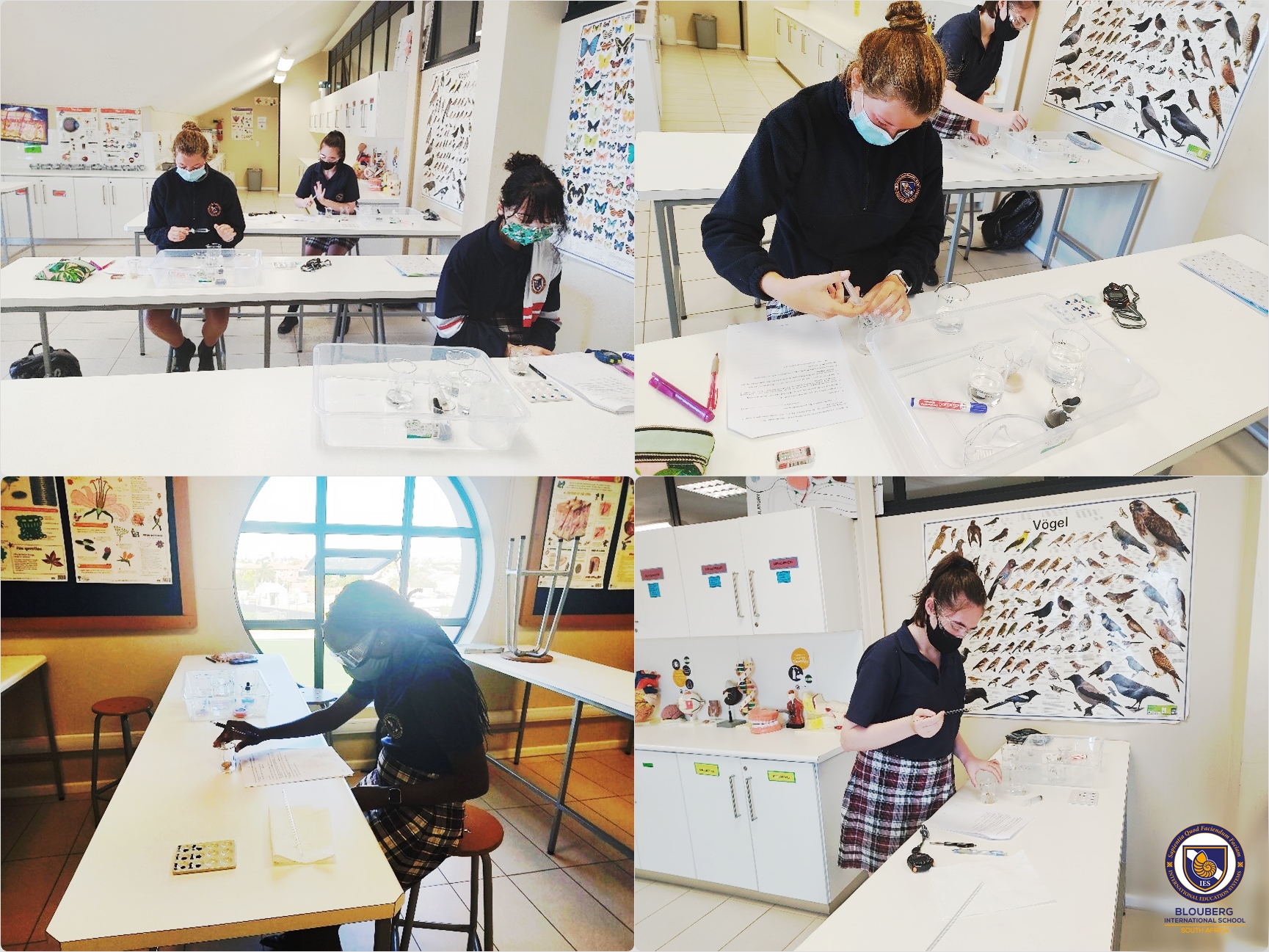
AS Level – We’ve made a gentle start in Year 11 as the jump from IGCSE to AS level is an intimidating one. We’ve spent many weeks discussing the ultrastructure of plant- and animal cells and the microscopy calculations associated with this chapter. A couple of microscope practicals were done to practice drawing skills and identifying structures in cells. Next, we looked at the building blocks of biological molecules and the chemical bonds that hold them together in complex arrangements. Currently we are investigating enzymes by comparing their affinities for their substrate and the commercial application of immobilizing them in alginate beads. A few “wet practicals” have also been done to practice the skills of diluting stock solutions using different methods, gathering accurate results and the ability to present these in a suitable table. The practical in the photos required students to test for the release of carbon dioxide from a suspension of yeast cells in a sucrose solution by using bromothymol blue indicator solution. This indicator will change to different colours depending on the concentration of carbon dioxide.
The Year 12’s finished the syllabus at the end of 2020, and we are currently revising by working through activities from a workbook and past papers. Practicals are also important to build confidence for Paper 3 at the end of the year.
A Level – We are firing on all cylinders, working through the A Level topics as this is typically a jam-packed and intense academic course. Various topics have been covered in great depth, from the biochemical pathways of photosynthesis and respiration, to how the kidneys regulate the osmotic potential of blood and tissue fluid. Currently we are delving into nervous and chemical coordination of animals, by looking at how action potentials are generated in neurons, the process of muscle contraction and how hormones regulate the female reproductive cycle. This has indeed been a very busy term.
Marlene Feltoe
IGCSE, AS and A Level Biology Teacher