
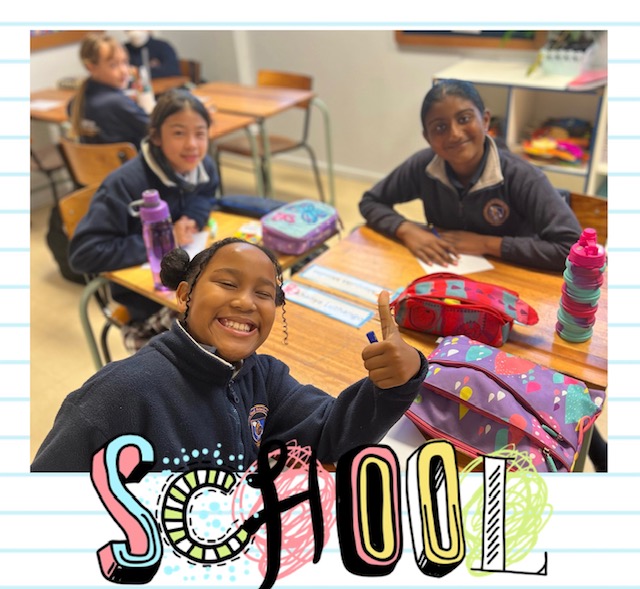
Moments And Memories
“Life is a beautiful collage of priceless moments and memories, which when pieced all together creates a unique treasured masterpiece” – Melanie M. Koulouris
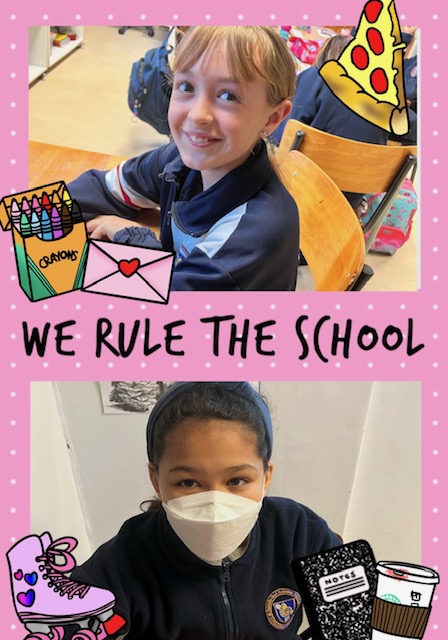
To start the new term, the Year 5’s were tasked with reflecting on not only the wonderful moments and memories they made during the holidays, but also on why they treasured them as a part of their life’s masterpiece. They were also asked to share these memories and stories with each other in groups and with the class.
Here are just some of the special memories our students shared:
The best moment and memory was probably cuddling with my dogs, because I’m obsessed with dogs! – Zoe Floor
My best moment is when I saw all the pretty trees in Canada and the hotels looked amazing; in Hermanus I went to the beach and saw dolphins and sharks. I love having fun and spending time with my family. – Bohlale Malatji
My happiest moment was a sleepover I had with my best friends in Shanghai. We had it in a hotel, especially for us! – Emily Yu
I went ‘glamping’ with my Mom; Step-Dad and my sister. I loved it because I went with my family and we were not allowed to bring our phones! – Sian-Lia Jenkinson
The best moment I had during the holidays was seeing my Mom. This moment was very special because I haven’t seen her in a very long time. – Unknown
It is, however, important to not only reflect on the past, but also to also look to and dream about the future. So for the second task, the Year 5’s were required to write down what they were most excited about experiencing this term. Here are some of their answers:
I am excited about the Aladdin play and doing work and getting higher marks in each of my subjects. – Khanya Luthango
I am excited for this term, because I won’t be wearing a mask! – Indiphile Jentile.
Making more friends, being happy and improving my sign language. – Zoe Floor.
I am excited about soccer this term and the new students. I also want to improve my marks. – Etana Mueke.
The Year 5’s are looking forward to a wonderful Term 3!
Jennifer Rose
Year 5 Teacher


Read More

From The German Club
Willkommen! Welcome to the new German Club!
The German Club was launched at the beginning of the year and has become a highlight of my week when 20 very enthusiastic German Club members meet on a Friday afternoon in my classroom for an hour. These members are students from Year 5, 6 and High School.
We cover various topics and themes as well as test and taste many different treats and snacks from Germany.
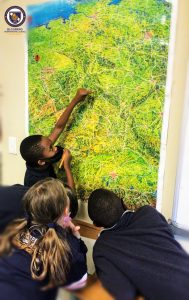
This term we explored the questions ‘Where in the World is Germany?’ and ‘Where in Europe is Germany?’
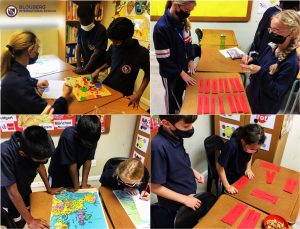
The students were divided into groups and rotated to different stations consisting of maps of the world, including Germany and a puzzle of Europe’s countries that they had to complete. They also had a questionnaire that needed to be answered as a group for each station. In this way, they were able to discover for themselves where Germany’s location is in relation to hemispheres, continents, oceans and then which countries, seas, rivers and lakes border Germany.
During Book Week in the German classroom, all the students were introduced to the fairy tales and stories by the brothers, Jakob and Wilhelm Grimm. We watched and listened to the animated story of the ‘Die Bremer Stadtmusikanten’ (The Bremen Town Musicians) and learnt a song.
Read the previous article here: https://blouberg.stjohnsdevon.desarrolloadhoc.com/2022/05/20/the-brothers-grimm/
In the German Club, we further explored this story and a highlight was watching a 60 minute movie with real live characters all in German with no English subtitles. The 4 animals; the donkey, dog, cat and rooster in the story could talk to the special humans, as they should of course in fairy tales.
In preparation before we watched the movie, we worked on the vocabulary from the movie by working in groups and matching the English and German words.
Parts of the movie were filmed in the German city of Bremen, which brought the story to life. The students really enjoyed the movie and we will definitely watch more in the future.
The German club also worked on a short play of the story and they presented it to the Year 1-6 students in the KS1 and KS2 assemblies this week. The students especially loved singing along to the song with much enthusiasm.
We look forward to the next term with the German Club.
Frau Kerstin Pani
Primary School German Teacher


Read More

Figurative Language: Putting Words To Work
I walked towards the door, my shoes squeaking on the tiles like nervous mice. The door at the end of the corridor gaped open, the wind whispering secrets between the hinges. I reached out and gripped the door handle, the metal a chunk of ice on this wintry morning. I checked that I had my book, and slipped into the English classroom, ready for my descriptive language lesson…
This term in English, the Year 6 students have been learning about figurative language, imagery in writing and the plot elements in a narrative plot structure (rising action, climax and falling action).
Their focus has been to include figurative and sensory language when writing, to help their writing pieces to become more descriptive. They used tools like similes, metaphors and personification (figurative language) to help paint a picture in the reader’s mind. They didn’t just tell stories, they created worlds. By using imagery (sensory details) in their writing, they transported their readers far and wide, taking them on adventures where they could see, hear, taste, smell or touch whatever the characters were experiencing.
For their final writing task, the students needed to apply what they had learnt, writing a story chapter that included the rising action, climax and falling action of their story, as well as using figurative and sensory language to help their readers visualise their setting and action. Of course, stories don’t just write themselves, and sometimes starting a plot can be tricky. To give them a jump-start on choosing their setting, students were given visual prompts of various possible settings and sensory details that matched them. They also made use of a bank of resources for metaphors, similes, personification, synonyms and adjectives, which they could use to describe the feelings and actions of their characters.
The Year 6s really stepped up to the challenge, showing that they could work independently, use their resources effectively, and give meaningful feedback on their peers’ work. They created impressive writing pieces, which I thoroughly enjoyed reading!
-“Wet, heavy drops splattered all over, like paint messily across a canvas, as their fire was quickly dying.”- Nuraan Price
-“He could feel his tears welling up again. They blended with the rain, bucketing down.”- Siyana Manawar
-“He stared forward examining the crude, rusty train tracks that seemed to go on for kilometres before disappearing into the thick ominous fog. He pinched himself on his forearm, hoping that this was all a dream, but nothing.”- Sadie E’ Silva
-“Jannet woke up to a crack as loud as thunder and shot up as fast as an elastic band”. – Aimée Davies
Katherine Nel
Year 6 Teacher and KS2 Coordinator


Read More

Aftercare And Holiday Care
At BIS our main focus for Aftercare is to provide support for students when formal school activities close for the day. Some of the benefits and value that students receive when enrolled in our BIS Aftercare Programme includes:
- Basic homework routines support by aftercare assistant.
- Fun activities such as reading, drawing, arts and crafts, movies.
- Basic needs are met which includes safety, a snack, play time.
- Strengthened relationships with peers and more quality time to spend with parents at home, as homework and other activities are completed at Aftercare.
We also offer a fun, interactive and structured Holiday Care Programme, where extra-mural activities and recreation forms part of the daily routine.
Some of these activities include:
- Participation in sporting activities to strengthen and develop physical and team building skills.
- Learn life skills through participation in a range of informal and structured activities that teach children how to cope with everyday situations.
We have an exciting Holiday Care Programme planned for the June/July school holidays; enroll your child by clicking on the link below.
Avril Lai Wing
Aftercare Manager




Read More
‘X’ Marks The Spot
This Term in Geography, the Year 3 students have been learning how to read a map, what map symbols are used for and following directions on a map. They also learnt a great deal about grid references and compass roses. This all coincides with History where we are learning about ‘Explorers’.
When investigating map symbols, the students had to create their own map symbols for the classroom. Once they had completed that, they used those symbols to draw a birds-eye view of their classroom to show their knowledge and understanding of the concept.
We extended the concept by playing directions board games and completed a compass challenge game in groups.
The best part of the whole term was that each student was given a chance to create their own treasure map, and present an oral about their map explaining how to get to the treasure using directional language. Each map had to have an appropriate name, a key showcasing exciting locations, feature a compass rose for directions and footprints to the treasure (x marks the spot).
Students were allowed to stain their maps with tea or coffee and burn the maps to age them so that it looks authentic. I remember doing this exact activity in primary school, so I was very excited to see what each student came up with. I loved the various locations they used, like skull caves, waterfalls, sinking sand and volcanoes, only naming but a few. The Year 3 teachers are super proud of how much effort all our students put into this task. I am sure that you will agree with us when you see their beautiful maps.
We will continue exploring maps and atlases for the rest of this term while discussing the various famous explorers. I cannot wait to do the scavenger hunt and I am certain the Year 3 students will enjoy it too!
Wendy Menton
Year 3 Teacher

Read More
Creating 3D Shapes

During the term, the Year 4 students have been learning about 3D shapes, forming part of their Mathematics curriculum. Through research, collaboration and investigation the students learned the names of these shapes as well as their properties.
As part of a class project, students were given the task of creating a structure/model using no less than three different 3D shapes. They had to construct each shape, using nets, before assembling their project. Our budding engineers worked tirelessly to come up with amazing designs and we could not be any prouder.
After the construction was complete, students had the opportunity to share their project with their peers in an oral presentation.
We are very proud of our students.
Yvette Fourie
Year 4 Teacher
Read More

Learning Using Models And Research
Learning is more than remembering terms and concepts. It is the start of a lifelong adventure of inquiry. The Year 3’s have been challenged and assisted in their research by using technology, observations, and secondary sources to study the Earth, Moon and Sun. What they have discovered, they have demonstrated using models.
Last Monday, the early risers had the privilege of seeing a Blood Moon. Aside from watching and discussing a YouTube video to learn what causes a Blood Moon lunar eclipse, they took photos and created a couple of beautiful collages of the Cape Town May 2022: Blood Moon.
The iPads have also been used to research lengthy websites and discover the 7 ways the Earth is round. They did this by simply using the subtitles as a reference. We also explored how to use Kiddle – a search engine designed for kids to use to find information quickly. We then moved on to using YouTube as we mined for diamonds of information on a Dr Bionics video about the structure of the Earth.
Of course an interactive way to display our knowledge, is to use models.
This term we have used our hands to demonstrate how the primitive (reactive) brain and the prefrontal cortex helps us focus and solve problems.
We made interactive lungs with cards, balloons and straws to show how air comes in through our nose and mouth and inflates our lungs.
We are especially proud of our plate models, which show the phases of the Moon; the names of each stage as the Moon rotates on its axis and orbits the Earth. Some students were even able to show where the Sun would be during a lunar eclipse.
Information that students find for themselves, discuss, and demonstrate their understanding of becomes a lived experience instead of a book study.
Carey Schoots
Year 3 Teacher


Read More
Multiplication Scavenger Hunt
In Mathematics, the Year 6’s have been learning about multiplying whole numbers by two digit whole numbers. They have learnt about many different methods to work out their answers such as the Grid Method, Expanded Written Method and Formal Written Method. This week they put all this new information to the test and took part in a Multiplication Scavenger Hunt.
The Year 6’s received clues such as:
– I’m a four sided shape but people call me five.
– Here we hold meetings and celebrate stars of the week. To find the next clue go take a peek.
– With clothes of green, and bark not of a dog. Search me for the goods, I sleep like a log.
– A site of work and getting things done, and making calls for your sore tum.
– Back and forth I take you, higher and higher you fly. At time you can push me and I might make you cry.
Can you figure out where these locations are?
When they arrived at their destination, they would find a task card waiting for them with a number sum or a word problem on it. Once they worked out the correct answer they could come back to me and receive their next clue. This turned into a competition, with each group trying to get to as many task cards as they could.
This was a lot of fun and a more hands on way of learning. It allowed the Year 6’s to show off their newly learnt multiplication skills, as well as practice other skills such as: team building, patience, group work and time management skills.
Brittney Hakime
Year 6 and 7 Mathematics Teacher


Read More

Sound
“Tell me and I forget. Teach me and I remember. Involve me and I learn”. – Benjamin Franklin.
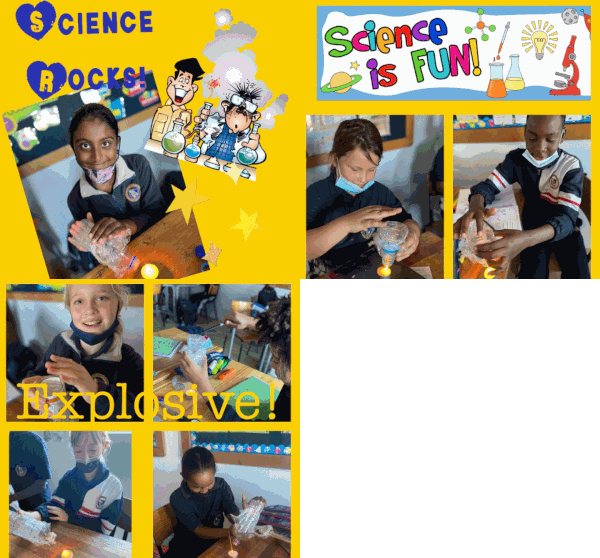
Our budding scientists in Year 5 have been learning all about how sound is created. As stated in the quote above by Benjamin Franklin, the best learning takes place when students are actively involved in the learning process. Hence, it was time for our students to put on their scientist hats and participate in some thrilling scientific experiments in class!
As seen in the pictures below, each student had to stretch a piece of plastic film tightly over the open end of a plastic bottle. They had to then light a small candle, causing endless excitement amongst the students! It was then that the fun started. The aim of the experiment was to test if sound vibrations travel through the air, as we cannot see them with our own eyes. If this theory was indeed correct, the flame would flicker when they tapped the bottom of their bottle!
And…EUREKA!
The experiment was a success and as any accomplished scientist would do…the experiment was done repeatedly and with much amazement by each student! After all the excitement, the lesson was concluded with some serious reflection, thinking, debating and discussion about our findings.
The best way to learn science is by doing science and to never stop questioning!
Jennifer Rose
Year 5 Teacher


Read More

Bright Science Sparks
“The Shadow Proves the Sunshine” – Switchfoot
The year 4’s have just completed a week of shadow investigation. On Monday morning we set out with a mission to discover how shadows move and change throughout the day. We started our lesson in groups by answering questions about shadows and light, discussing what we already know and what we still need to learn. It was key for every group to cooperate with one another by being polite and kind to the other members of the group. Sharing and taking turns was also a key factor in working towards a group agreement on their answers.
Our research starting point was making predictions about how the shadow would move or change. A simple upright pencil on cardboard was all we needed to set this test in motion. Our first observation was that light always travels in straight lines. Anything in the way would cause a shadow. Throughout the day, in fact every hour, we witnessed that our shadow moved to the east. Our pencil shadow was long in the morning. As the day progressed the shadow became shorter, being the shortest at noon. After midday the shadow of the pencil slowly grew in length again.
Our testing was not yet complete! Working in groups again, we investigated which objects were transparent, translucent and opaque. We also discovered that we could change the size of our shadow by moving closer or further away from our light source. After collecting and recording our observations over the course of the week, all our findings were crafted into games.
Looking back over this week it is clear that every Year 4 student has taken ownership in this investigation. In return, this will create a sure scaffolding for future light exploration.
Carol Blake
Year 4 Teacher


Read More