

Valedictory and SRC 2022
Although things looked a little different at BIS this term, we are so fortunate that our students were able to attend school for the majority of the term. Thank you to everyone who supported the staff and students through this journey.
We will continue to ensure that the curriculum is comprehensively covered, ensuring that we stay on track for the rest of the academic year.
Our sincere thanks go to the teachers for all their hard work with the planning and delivery of the online lessons, as well as the teaching of the students in the classroom.
On Wednesday, we held a special Valedictory & Prize-Giving Awards Ceremony on the school campus for the Matric Class of 2021, joined online by students and parents. Ceremonies like this one enable us to pause as we recognize, acknowledge, and celebrate our students’ success and development.
We also had the pleasure of announcing the 2022 SRC Leadership Team:
Remy Wang
Michael Mkandawire
Rifqah Price
Kazimla Dyakalashe
Savanna Prinsloo
We are so incredibly proud of all the year 11 students who nominated themselves and gave speeches a few weeks ago. Whether they have received a formal position or not, they will all be incredible leaders for our school in 2022. I have no doubt that they will work hard to make our school an even better place by upholding our school’s values throughout the year.
This holiday is a short one, and I hope that you have time to rest and recuperate.
We look forward to welcoming our students back to school on Wednesday, 29th September.
Carmen de Villiers
High School Coordinator

The upcoming Cambridge IGCSE and AS/A Level examinations and how to prepare for them
The October/November Cambridge IGCSE and AS/A Level examinations are fast approaching, with the first examinations already taking place on 28 September 2021. It is vital that students prepare themselves for these examinations.
Below are some helpful hints and tips for preparing for the examinations:
- Familiarise yourself with your examination timetable.
- Ensure that you know exactly:
– what work will be covered in each subject;
– the format of each examination paper;
– the time allocation;
– the equipment that may be needed for the examination (e.g. calculator for mathematics).
- Get copies of old examination papers and worksheets.
- By now, all your notes should be up to date and you should have all that you need to study effectively for the examinations.
- Prepare your study area. Some things to consider are:
– have a good source of light;
– have lots of paper available;
– a clear work surface;
– coloured pens if you prefer to use colour;
– light or unobtrusive music if you prefer to learn with music.
- Keeping healthy! Eat fresh foods such as fruit and nuts. Pile up on the vegetables in the evenings and drink plenty of water and fruit juice to keep the flu at bay. The brain needs to be fed well to perform at its optimum.
- Try not to nibble on too many chocolates and sweets while studying.
- That said, the odd sweet or chocolate will provide an energy boost when you feel really tired.
- Getting a good night’s rest is also important. Sleep will rejuvenate you and keep you going.
Devising a Revision Timetable:
If you plan your revision carefully, you will enjoy the feeling of being well prepared for the examinations, secure in the knowledge that you have done your best and have covered all the work.
- Create a calendar for this purpose, using bright colours/larger paper etc.
- Start by marking in the dates and times of your examinations.
- Shade in the dates and times when you know you have other commitments, e.g. sports fixtures/family function.
- Work out how much time you would need per section per subject. Remember to spend more time on those subjects you find more difficult.
- Using a pencil, begin to draw up your revision timetable by writing in the subject and the sections that you wish to cover each day.
- You could leave a revision time blank each week, as a “safety net” for work not covered as planned. This may be as a result of those unforeseen circumstances that make life interesting.
- Do not get stressed out if you don’t stick rigidly to the timetable. Sometimes you start by expecting to cover too much at one time. The main idea is to get you to focus on the work that needs to be covered and to work towards a goal.
- Be sure to timetable rest and relaxation.
- Before changing subjects, take a longer break of about 20 – 30 minutes and try to get outside or do something different.
Study Methods:
Each one of you will have your own method of studying and it is important that you feel comfortable with your chosen style. It is equally important that you admit if your method has not worked in the past.
Here are some tips that you may like to try out. These are tried and tested methods.
- Start by reading through a section from beginning to end. This will give you an overview of what is to come. Focus on headings and pictures and diagrams.
- Ask questions as to the content of the section (why, what, when, where, how and who?). This will help to get your mind in touch with the main areas within each section (e.g. What do I need to know about this topic? What exactly is this text about? How does this section link up with what I have just studied?).
- Re-read the passage with the aim of answering your questions. Look up words you do not understand, refer closely to graphs and diagrams, highlight important ideas in colour, etc. Do not try to make notes at this stage.
- Aim to check that you have understood the work. Think about the passage and focus on key points. Re-read the passage, making notes on the relevant material. This may take the form of block notes or diagrammatic notes e.g. mind maps/spider diagrams.
- It is a good idea to redo mathematics exercises and worksheets as well as work through past papers.
- Diagrams can become excellent forms of summary in subjects such as geography and biology. A diagram should be drawn clearly with large labels for easy identification.
- When encouraging a difficulty concept, try to break it up into smaller units and talk your way through the steps of the problem.
- If you have difficulty remembering something, pin up key words on your bedroom wall or cupboard door as a constant reminder. Each time you walk past the word, stop, and ask yourself a question or two about it to trigger a response.
- In language, you need to understand the rule to apply it, e.g. rules for the past and present tense.
- Review. Aim to ensure that you remember what you have learned by reviewing worksheets/past papers/testing yourself with questions that you set or working with a friend and testing each other verbally.
Just before the examination:
- Get a good night’s sleep.
- Have a good breakfast.
- Arrive at the venue with time to spare.
- Make sure you have the right equipment, tissues, watch, etc.
During the examination:
- Don’t rush into answering questions.
- Read the instructions at the beginning to ensure that you know how to answer all the questions and how many questions to answer.
- Read through the questions carefully.
- If there is a choice of questions, make your choice carefully. Underline key words in the questions.
- Stick to the time plan given to you by your teacher.
- At the end of the examination, if you have time, read through your paper to check that you have answered all the questions.
I would like to wish all students the best with their 2021 examinations.
Julian Harrison
Cambridge Examinations Officer
Read More

Year 7 and 8 Art
Art, caft and design embody some of the highest forms of human creativity. A high-quality Art and Design education should engage, inspire and challenge students, equipping them with the knowledge and skills to experiment, invent and create their own works of Art, Craft and Design.
As students progress, they should be able to think critically and develop a more rigorous understanding of Art and Design. They should also know how Art and Design both reflect and shape our history, and contribute to the culture, creativity and wealth of our nation. Therefore, exposure to various fields and techniques is what Art in Year 7 and 8 is all about.
At the start of Year 7, we focus on the formal elements of Art as well as the principles of Design. These make up the foundation needed to create all artwork.
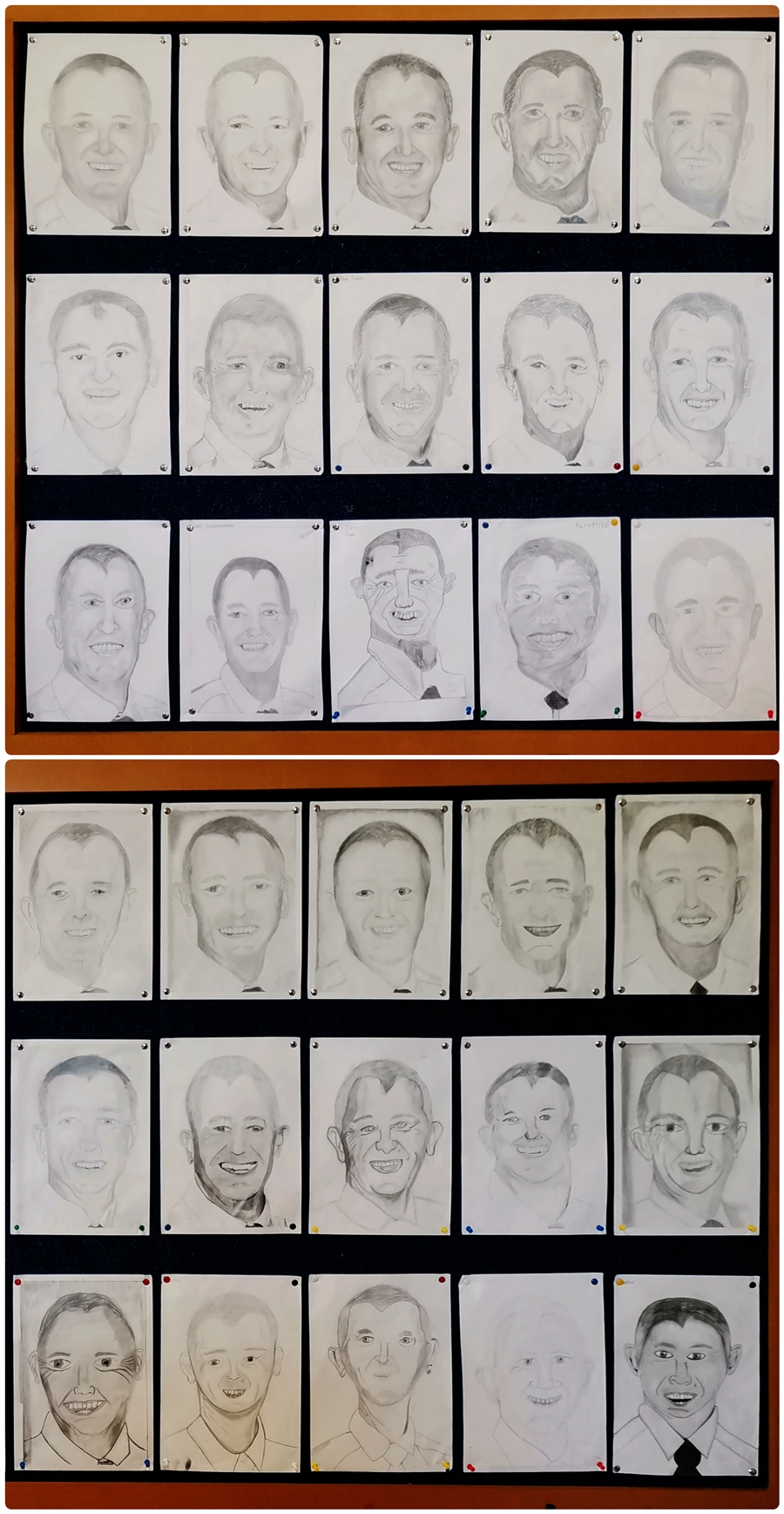
During Term 2, we started with teaching students the skills to draw different facial features. After this, they had to put their newly acquired skills to use by drawing a portrait of our principal from a photo. The results are astounding. This is in preparation for Year 8 where they do self-portraits.
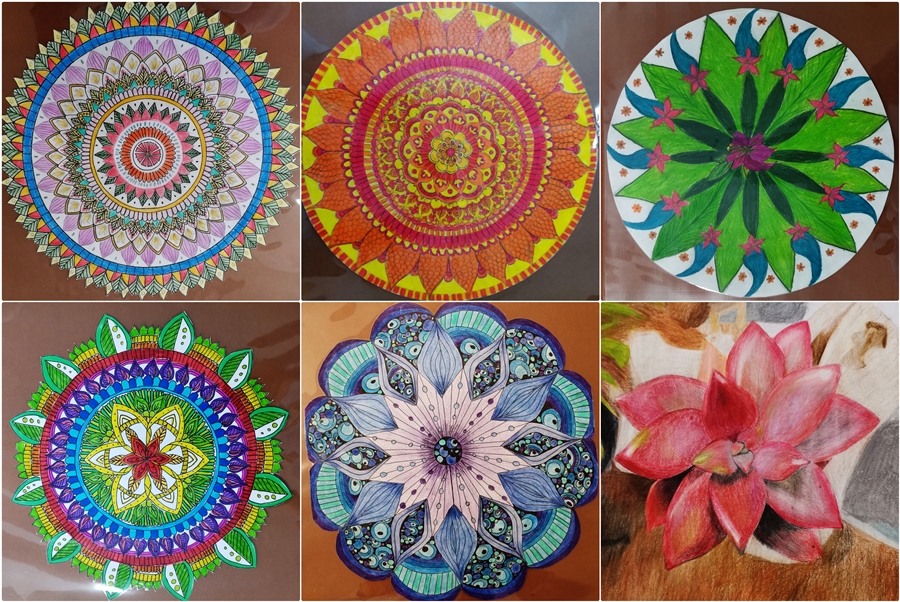
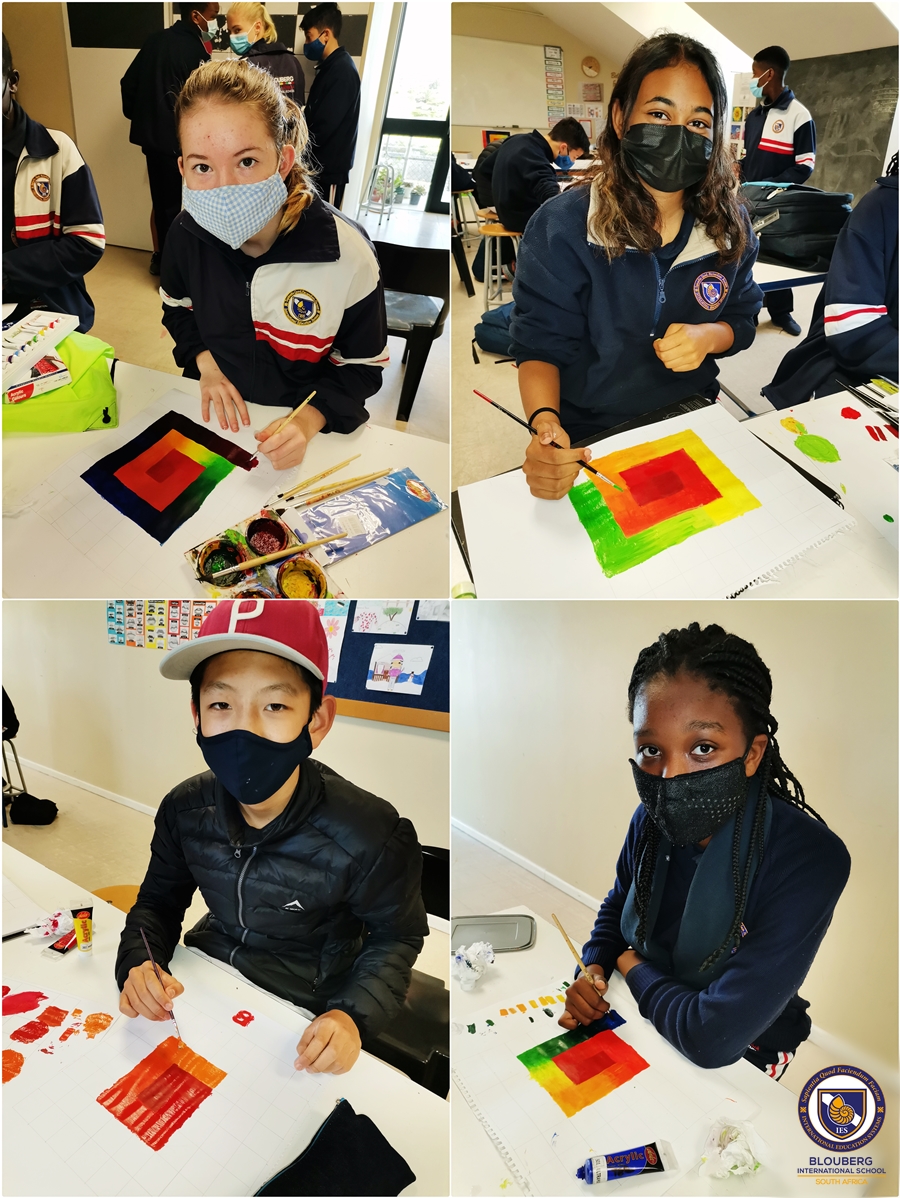
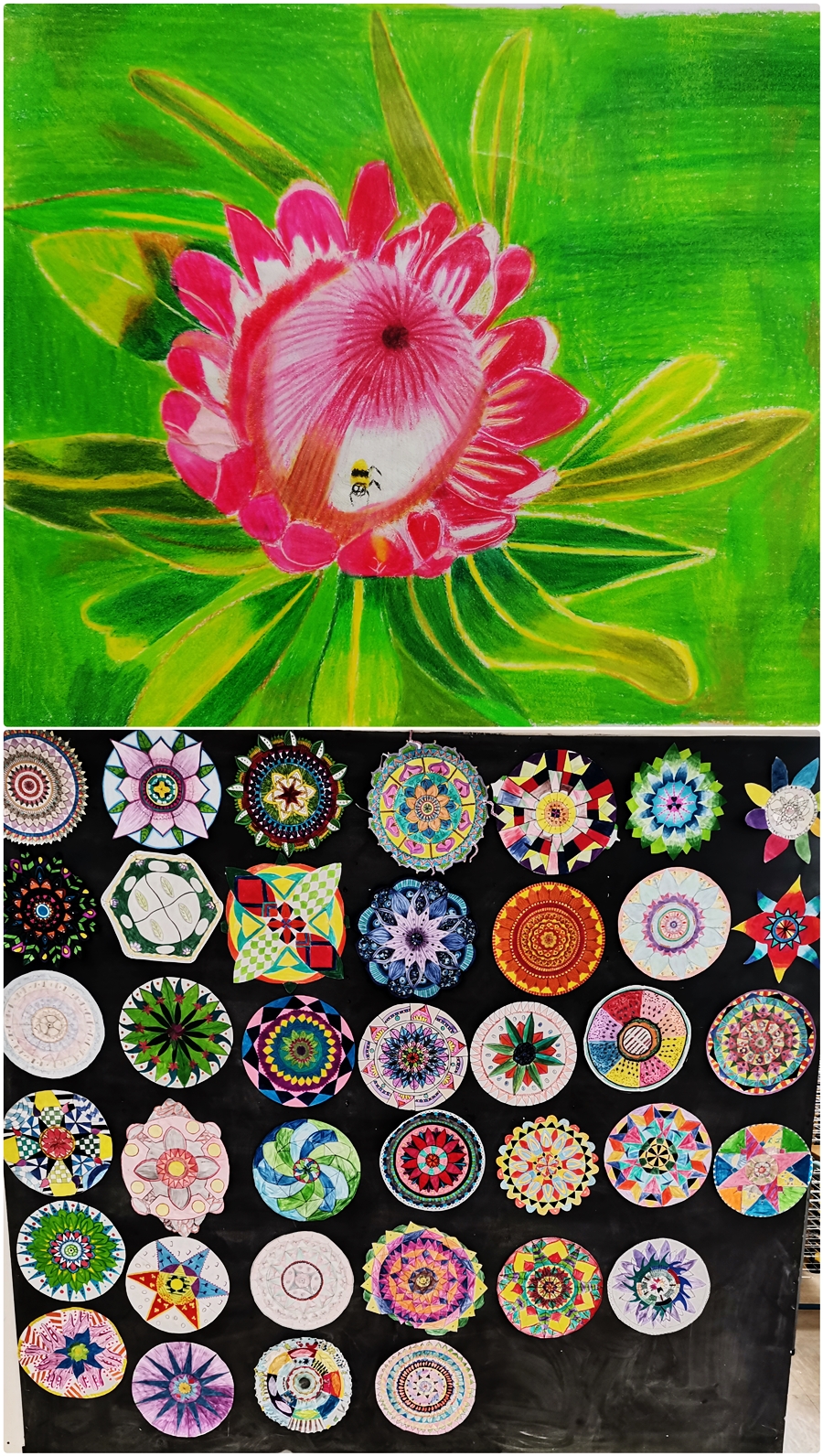
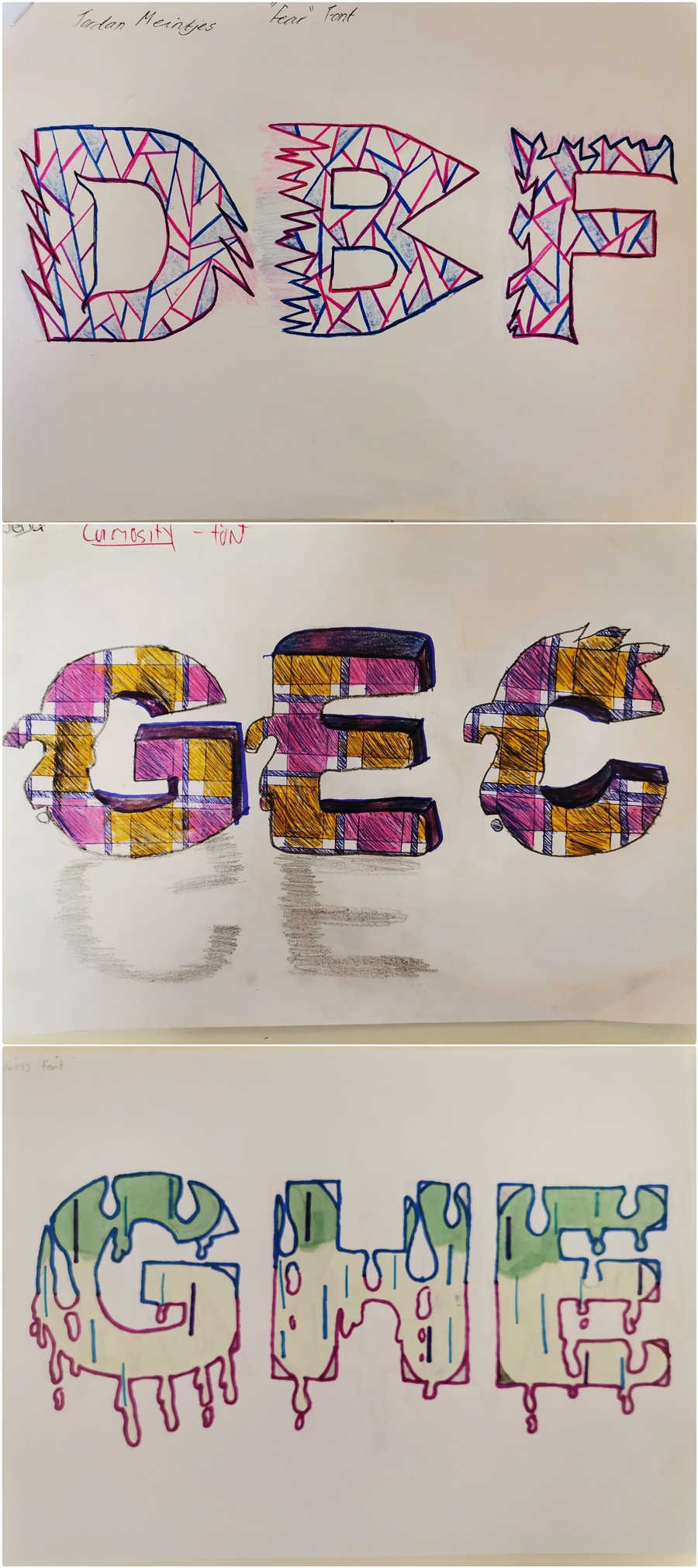
Colourful Mandalas were the order of the day in their June practical exam. This served as yet another opportunity to show their creative skills and freedom of expression. Currently the Year 7’s are busy with paint blending while the Year 8’s are exploring the world of Graphic Design. They are designing their own emotion-inspired font and using this in further practical tasks.
In Term 4, both Year groups will be exploring other areas of Art and Design as well. The purpose of exposure to the various areas of Art and Design is to help students make a more informed decision when it comes to taking Art as a subject at IGCSE or AS Level.
Art in Year 7 and 8 is exciting, challenging and a test for student’s creativity, thinking, hard work and dedication.
They say a picture is worth a thousand words so here are a few examples of what the Year 7 and 8’s have been up to thus far in 2021…
Ane Gornall
Year 7 and 8 Art and Design Teacher


Read More
Why do the President’s Award?
71% of business leaders and 63% of young people asserted that formal education alone is not enough to equip young people to be world ready. According to business leaders surveyed during the 2020 Global Survey; the following skills in the order of importance are considered in helping young people become ready for the world out there:
– Individual skills, such as confidence, resilience and determination.
– Analytical critical thinking and problem-solving skills.
– Social skills, communication, teamwork and leadership skills.
– Humanitarian skills such as empathy, adaptability, intercultural and civic engagement.
– Technical ability, technical knowledge and practical technical skills.
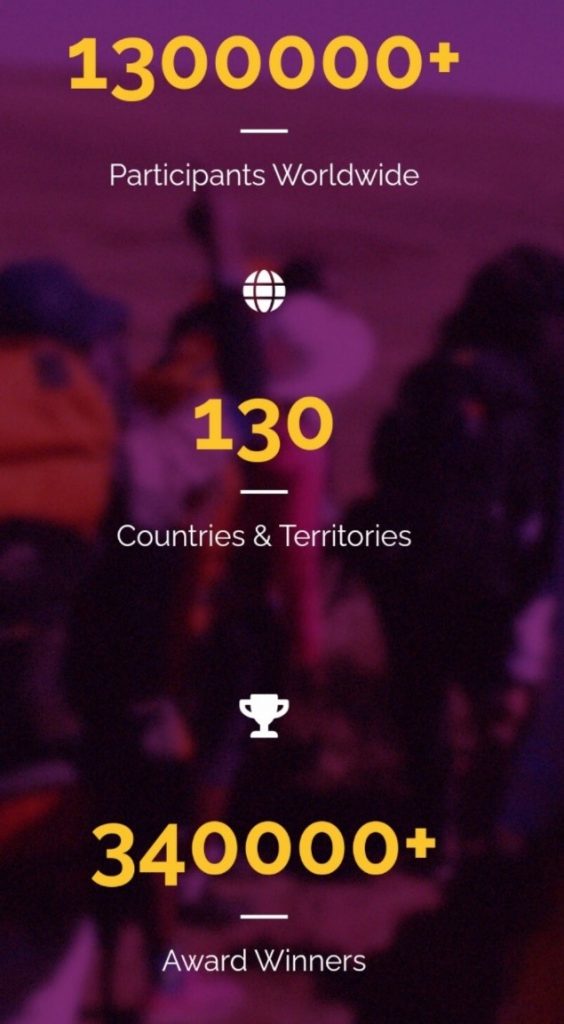
Achieving The President’s Award will give participants the skills, confidence and an edge over others when they apply for college, university or a job. Beyond their academic achievements, universities want to see evidence of so called ‘soft skills’ that they have developed through extra-curricular activities, such as communication, commitment, leadership and teamwork. The President’s Award is a fantastic way to demonstrate these practical skills.
The President’s Award equips young people for life through the development of universal skills enabling them to become responsible, committed, dedicated citizens. It provides a framework for non-formal education and has set guiding principles, with proven outcomes for young people who complete the Award.
It creates experiential learning opportunities to help young people discover talents that do not necessarily show up in the classroom context.
The programme brings together practical experiences and life skills, building confidence, encouraging physical health and recreation, and motivating young people to engage with their communities.
For the thousands of young people who take part in developing themselves through the President’s Award each year, the benefits of achieving The President’s Award at any level are endless. The Award is about helping you along the path to a productive and prosperous future. Many of our participants say that it’s a life-changing experience. Participants will make a difference to other people’s lives and their community, be fitter and healthier, make new friends and memories to last them a lifetime.
Participants undertake regular activities in four main sections:
– Physical Recreation
– Voluntary Service
– Skills
– Adventurous Journey
The Award is comprised of three levels and four sections. Participants complete all four Sections at each level in order to achieve either their Bronze, Silver or Gold Award. At Gold level, participants also complete a Gold Residential Project.
Here follows the requirements of each level:
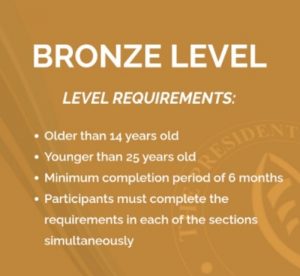
Bronze level requirements
Older than 14 years old.
Younger than 25 years old.
Minimum completion period of 6 months.
Participants must complete the requirements in each of the sections simultaneously.
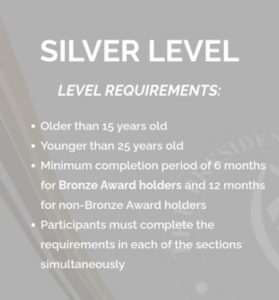
Silver level requirements
Older than 15 years old.
Younger than 25 years old.
Minimum completion period of 6 months for Bronze Award holders and 12 months for non-Bronze Award holders.
Participants must complete the requirements in each of the sections simultaneously.
Gold level requirements
Older than 16 years old.
Younger than 25 years old.
Minimum completion period of 12 months for Silver Award holders and 18 months for non-Silver Award holders. Participants must complete the requirements in each of the sections simultaneously.

“South Africa’s youth are our future. Developing their potential is a top priority in our country. One practical way is to develop this huge reservoir of talent through their participation in The President’s Award Programme. The young people must take it upon themselves to ensure that they receive the highest education possible so that they can represent us well in the future as future leaders. ”
– The President’s Award Founding Patron-in-Chief, Mr Nelson Mandela.
To register for The President’s Award please contact Mr Riaan Vosloo,
email: riaan.vosloo@iesmail.com
Riaan Vosloo
High School Teacher and President’s Award Coordinator


Read More