

From the Principal’s Desk, 29 May 2020
We are slowly but surely moving towards the end of the term. I wish to let you all know that your efforts and support of our teachers has not gone unnoticed. It has taken courage, commitment, and tenacity to accomplish what we did this past term and for that, I thank you.
As communicated in our ‘Return to school’ letter, as well as in our Health and Safety Policy document, Blouberg International is ready for the next step. Although we do not have all the answers, I wish to put your minds at ease that the staff of Blouberg International is committed to the safety and education of our children as we enter this next phase of lockdown.
We all have managed to make the best of a difficult situation and we cannot sugarcoat the situation we find ourselves in. There has been many frustrating moments, disappointments, and heartaches. I am particularly mindful of our class of 2020 as there are so many things they are missing out on. There is uncertainty as to whether we can hold their 2020 Valedictory Service and Matric Dance (to some this might seem insignificant, but it is an important event for the matric students).
So how do we help our children process the anger and disappointment they are feeling? They have not been able to socialize with friends for over 60 days and miss their friends, sports, school (bet they never thought they would). They have all had to adjust to a new type of abnormal normality.
- Validating what they are feeling and their emotions. We are validating the emotion, not the behavior. It is important to understand what they feel is real and therefor they need to talk it through to overcome it.
- Create a sense of security within them. They should always be aware that there is a safe haven with you. Reassurance, routine, and regulation is important.
- Increase children’s self-efficacy. Children often feel more in control of their emotions when they can play an effective role in helping themselves.
ENCOURAGEMENT
“In the midst of hate, I found there was, within me, an invincible love. In the midst of tears, I found there was, within me, an invincible smile. In the midst of chaos, I found there was, within me, and invincible calm. I realized, through it all, that in the midst of winter, I found there was, within me, an invincible summer. And that makes me happy. For it says that no matter how hard the world pushes against me, within me, there’s something stronger- something better, pushing right back.” – Albert Camus
I wish you all a wonderful weekend ahead.
Regards
Edna

Erfolg hat drei Buchstaben. TUN!
Goethe
As one of the arguably most famous German authors said – You can only achieve success through doing. This term has proven this to me again.
Eight years ago I did a course in modern language learning methods using technology. We learned about blended learning, flipped classrooms and different websites to use. Since then a lot has changed and throughout the years I always wanted to implement more technology in teaching. Unfortunately, it never came to fruition since teaching the traditional way was just easier and more accessible to students. This lockdown has forced us as teachers and students to finally use all those technological tools out there.
Learning German with online tools has never been easier. The German government has supported the teaching of German in other countries for years now and therefore we have many different online platforms to choose from. Sites such as Deutsche Welle and Lingoni offer great Video learning tools. Duo Lingo is a fun way to support what is learnt in class with fun activities. Additional to this it has become a lot easier to create your own online Quizzes or videos to share with students.
Even though this time has been trying and difficult it was a great step forward. Practicing a language does work better in a classroom setting, and will never become unnecessary, but the past couple of months have shown me how language learning can also be successful through other means. If you never try you will never learn.
Sabine Jahnke
German Teacher

My Own Filter
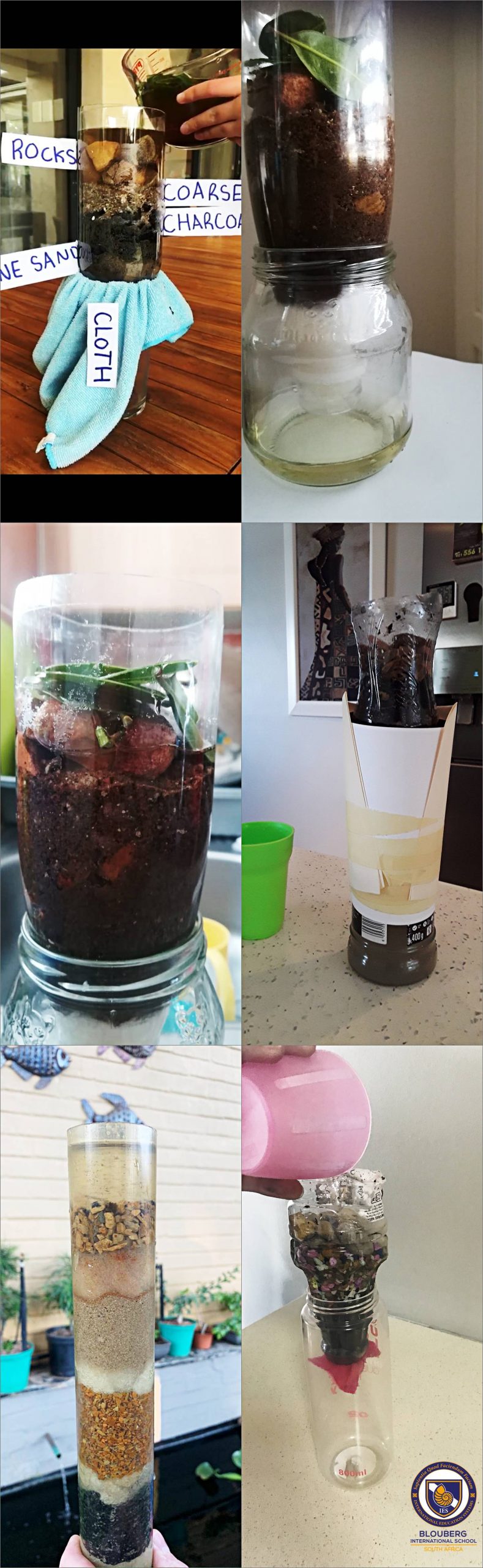
To end off our science chapter, “Material Changes”, for the term the Year 6 students explored how to make their own filtration system. Their goal for this activity was to discover that ground materials can clean and purify water before it is returned to the surface.
The criteria for the investigation was that their filter system needed to be durable and easy to use, have three layers and the layers needed to be made of ‘natural’ materials that they could find in their yards or nearby park. They could also make use of recyclable materials.
Let’s see what the Year 6’s had to say about their experience:
I really enjoyed my filtration project. It was so fun making the filter because you had to make important decisions on how you were going to layer your materials. It was really fun and I hope we get something like it again. – Maia Davies
What I liked most about the project was collecting all the materials especially the gravel because people were looking at us very weirdly. I enjoyed all of it and it was a great experience. – Glanville Morgan
What I enjoyed the most was experimenting with the different materials and finding out if they filtered the water. Knowing that a material that I tested worked and filtered the water made me fill with joy. I learnt that if natural filtration did not exist most of the fresh and clean water we have would be dirty. I also learnt that different materials have a different impact on how it changes the water. – Saumya Maharaj
I enjoyed making the actual filter, choosing what to put inside it and what should go in first. I learnt about how natural items ,like sand and rocks, can actually clean dirty water and about how charcoal removes toxins from dirty water without removing important minerals. – Faith Chivaka
The thing that I have enjoyed the most was how filtration works. We have learnt that the filtering system removes redundant or unwanted particles in dirty water. Filtration is a process used to separate solids from liquids using a filter medium that allows the fluid to pass through but not the solid. – Teeyana Shaik Mahomed
We would like to congratulate our students for doing a phenomenal job at completing this project.
Katherine Nel
Year 6 Teacher

Read To Me!
“The more that you read, the more things you will know. The more that you learn, the more places you’ll go.” – Dr. Seuss
Here are 10 reasons why reading is important for children:
- Improves concentration.
- Improves memory.
- Discover other parts of the world.
- Brain exercise.
- Boosts critical thinking skills.
- Develops empathy.
- Develops & expands language skills.
- Enhances imagination.
- Better performance in school.
- Source of entertainment.
https://www.readingrockets.org/article/reading-your-childhttps://www.edarabia.com/why-reading-important-children/
Siobhan Hendry
Year 2 Teacher


Spanish Tech
I read recently that human intelligence is the ability to adapt; an intelligent and solidary society will only take the good and discard the bad out of these difficult times we are all crossing.
From a learning perspective, there is a lot of good which has come from the lockdown. The current circumstances have forced many educational institutions and platforms to offer free online courses, free access to libraries, virtual museum walks, online concerts … all available to us from the comfort of home.
I still believe learning a foreign language online is not the ideal method; the personal, face to face contact of our daily lessons is irreplaceable, but if we combine both, learning online platforms can be extremely helpful.
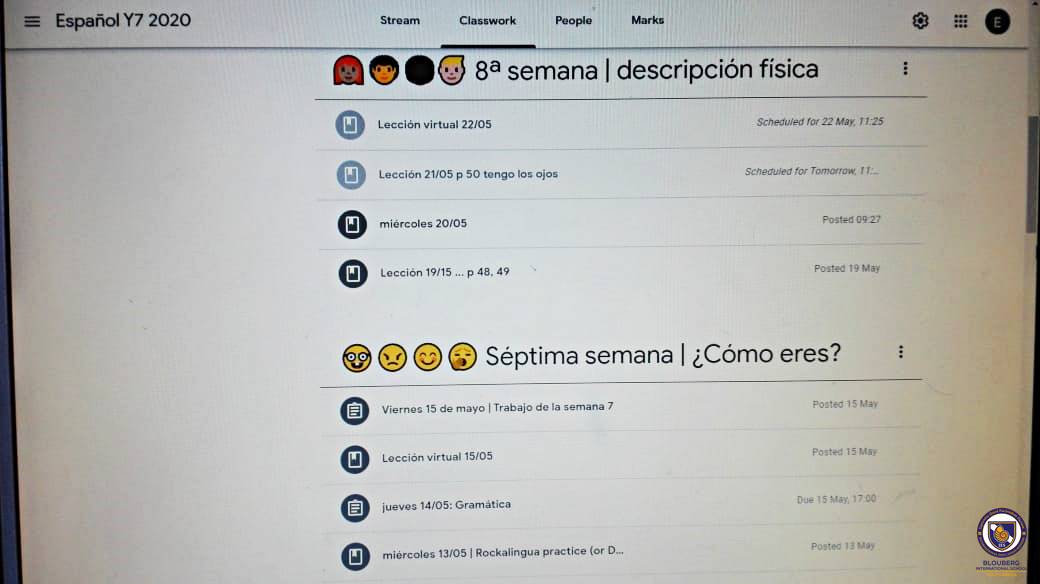
My Year 7 and 8’s are currently enrolled in Rockalingua (courtesy of our eager Spanish Primary teacher, Javier Vidal); although some of them prefer Duolingo. These online platforms promote fun and interactive learning through games, pictures, videos, and some form of goal to keep them motivated and engaged.
Another free online platform that has particularly good feedback is called Memrise. It offers lessons from beginner level to advanced Spanish. Memrise also teaches grammar and is particularly helpful in learning specific vocabulary by placing the new words in context. This is a more effective way for the brain to assimilate new knowledge, as it is now a meaningful task to complete, as opposed to having to memorize random lists out of context.
Whatever the choice, let us stay safe, focus on the good and make the best out of our online learning experience.
Elena Berger
Year 7 to Year 13 Spanish Teacher

From the Principal’s Desk, 14 May 2020
Dear Parents
I am sure that, like me, you have mixed feelings about the President’s address last night. Earlier this month, the 5th of May 2020, you received a letter regarding potential dates for the return to school and the measures which need to be in place before this is possible.
Although we are an independent school, we are obliged (as are government schools) to await confirmation from the government before we reopen. Originally, we were informed that students in Year 7 and Year 12 would be returning to school on the 1st of June 2020 and hence, management took the necessary measures of ordering hand sanitizer, face masks, thermometers and having the school deep-cleaned.
The Minister of Basic Education, Mrs. Angie Motshekga, is scheduled to address the nation on Monday the 18th of May, after which we hope to have a better idea of which grades will return to school. The results of our second survey, regarding students returning to school, indicated that 75% of parents are not willing to send their children back for the two weeks before the end of the second term (which ends on the 12th of June 2020). We respect and understand your feelings in this matter and hope to reassure you that the best interests of our students are always at the forefront of our planning. To accommodate the needs of all our students, we will therefore implement a plan of hybrid teaching for as long as is required.
A letter detailing the plan of action for Blouberg International will be sent to you after Minister Motshekga’s address on Monday. Let us continue building our children and planning for a better future for them.
In the words of Nelson Mandela:
“It is so easy to break down and destroy. The heroes are those who make peace and build.”
Have a wonderful weekend
Edna

Teaching Design and Technology Online
By the time you read this we will have been under lockdown for 49 days… who would’ve thought? Two weeks became 3 weeks then it was extended again or was it the other way around?
When we started online teaching most of us felt lost and must have watched the various “how to” videos at least 50 times. Now however, 49 days in, it’s old hat. Teaching Design and Technology has made me realise that things are always changing, and people are always looking for innovative ways to produce new products.
When reflecting on the situation in which we find ourselves today, I cannot help but think that Design and Technology will play a huge role in the future. For example, think about all those Zoom meetings you have attended. Now, as you know, you can change the background, but how professional is that Eiffel Tower in the background? Is that the look you want when hosting that all important board-meeting? I see that there is a South African company that sells professional-looking office and boardroom backgrounds. They can even recreate your actual office so you and your staff can feel right at home. Isn’t it amazing what Design and Technology software can do?
In Design and Technology, students are taught to improve the design of an existing product or design a something completely new altogether- the aim being to create something which will make our daily lives that little bit easier. My students are busy designing health care facilities made from shipping containers, vertical farming installations, fold-away study tables and an eco-friendly school, to name just a few of the exciting projects we have underway.
I am sure that we are all looking forward to seeing their final designs.
Julian Harrison
Design and Technology Teacher

Learning About Reptiles


From the Principal’s Desk, 30 April 2020
Dear Parents
Like me, I am sure all of you have been following the news avidly, waiting for an announcement from the Minister of Education which will see us return to school. The process of returning to school is a balancing act in which we weigh the need for students to return to the classroom with the necessity of ensuring everyone’s safety. Rest assured though that when the day comes when we do return to school, there will be strict safety measures in place to ensure the safety of everyone on campus.
When I think about returning to school, I realise the enormity of the task ahead of us; the factors we must consider and the preparations which need to take place. Even our ‘drop and go’ routine in the mornings will have to alter radically. We will have to screen temperatures and ensure that all the classrooms remain hygienic throughout the day. It will be a continuous process of sanitizing: hands, doors, desks, bathrooms and corridors. And let’s not forget the all-important face masks!
The questions which roll through one’s mind as we contemplate the process follow a common pattern: Will the children understand the requirement of social distancing? How will we handle classroom management? How do we prevent contact and overcrowding? All these questions and so many more are exactly what we Heads mull over together.
This week we started with our first online assemblies. The responses from 198 students on one platform at the same time was overwhelming, but then as I watched I could see the excitement on their faces and I realized that it was being together again which was evoking such an enthusiastic response from the children. After a vigorous run of muting everyone so we could hear ourselves think, we were able to begin the assembly. We listened to Mrs. Schoots deliver words of encouragement and handed out star certificates. Our second attempt the following day was much smoother and less chaotic.
I am reminded once again of the lessons which we learn something from our children. They have an incredible ability to be resilient in any crisis. They adapt and thrive to any challenging situation we immerse them in and grow to be even stronger than we thought possible. Our involvement as parents in their education is crucial during this difficult time as their daily struggles and achievements provide insight into their development and character.
Let’s not walk away from experience without taking some good lessons with us. Together we are better.
Have a wonderful long weekend!
Edna

Lockdown Learning
What Shakespeare can teach us about surviving online learning.
What do we English teachers do when times are tough? We look to the Bard of course! Who better to guide us through the online educational space than a writer who has been dead for over 400 years! Now before you scoff “nonsense” over the rim of your coffee mug and scroll to the next page, let’s consider this in a little more depth. The transition to online learning has been challenging for students and teachers alike and we have all been plagued by fears and doubts. First Language English is a subject which you may consider one of the easier subjects to study online and perhaps you have a point. I can email you a poem- you can read it- you can write me an essay about it. Bob’s your uncle, done and dusted. Bring on the next one… Well, not quite.
Why does an author write a book? Obviously they want people to read it, but more than that, they want people to talk about it; it’s the hushed conversation in smoky cafes, the heated discussions over a plate of Thai chicken niblets at an annual Book Club meeting and the dog-eared, coffee stained pages of a favourite book passed from parent to child. Literature provokes dialogue and debate and as I always say to my students “It’s okay to hate the story you’ve just read, but you must be able to tell me why”. Stories, poems, plays- they are meant to be read and shared and isn’t it a truism that it is just as satisfying to discuss something you love as something you hate?
This is why I want to be back in my classroom! Not just for my view of the mountain, but for the interaction; the back and forth across the classroom, the heated opinions and different perspectives which mingle and lap the edges of the room like a gentle wave on a summer’s day.
Simply put, it’s a lot more difficult to discuss a work of literature isolated from each other as we currently are. You can read the play yourself, sure, but where’s the fun in that? A play isn’t meant to be performed by one person, now is it? My belabored point is that teaching First Language English online is a challenge and no Zoom meeting or Google Hangout Meet can replicate the wonderful disorder of a good class discussion.
Back to my original point. So, what do we do when we feel the pressure, the stalking fear and self-doubt that comes with being chucked in the deep end of the pool and having to paddle like a crazed duck to stay afloat? To whom do we turn when the challenges of online learning become all too real? Why, to Shakespeare of course! As usual, our dear Bard has a few life lessons up his sleeve to help us cope.
- “Our doubts are traitors, and make us lose the good we oft might win, by fearing to attempt.” We have all suffered the pangs of fear and self-doubt in navigating online learning and adapting to different methods of teaching. We should not doubt our abilities, for nothing ventured is nothing gained, and I am fairly sure our students are prey to the very same emotions which trouble us. We are capable of a lot more than we think- from teachers, to students and parents and self-doubt is the enemy of success.
- “Give every man thy ear, but few thy voice.” Learn to listen. Perhaps the most valuable exercise I have done during online learning is to have my students to talk to me, rather than I to them. “Tell me the truth”, I say to them. “How is it really going?” I have spent many minutes at the beginning of online sessions just listening… listening to the complaints, the fears, the excuses and you know what? I really have learnt a lot. I am learning what is working and what isn’t. Online learning is a collaborative process and if both sides are honest about their expectations and progress, then the game is half won.
- “Better three hours too soon than a minute too late.” Don’t be late. Shall we leave it at that and move on?
- “Pleasure and action make the hours seem short.” Keep busy and keep your mind active. I always imagined myself as the perfect lounge lizard, but to be honest, if I wasn’t working, I would’ve gone mad on Day 3 (Day 4 if Netflix released Outlander season 4). It’s important to keep ourselves busy and I don’t just mean with hours of admin and slog in front of the computer; I mean busy with activities which stimulate the mind. This goes for our students as well- research tasks which require them to think and engage with material. I enjoy setting argumentative and discursive topics for my students; topics which require them to have a good think and do a bit of research to support their opinions. They had to write a magazine article on the topic of cosmetic surgery and boy, the opinions flooded the room like bees after Pooh’s spilt honey pot. But they were engaged, I can promise you that.
- “The miserable have no other medicine, but only hope.” I’m sure we’ve all felt the cold tickling of misery at least once during lockdown but on the bright side, as the saying goes, there’s no way but up from here. Shakespeare reminds us that the doldrums only increase our focus on the horizon and the calm flats which lie ahead. Let us remain positive and instill this positivity in the students. Complaining may be temporarily cathartic but does little good. We are learning new skills, finding hidden talents and drawing on resources we never knew we had. It’s an adventure and like all good tales, it starts out filled with peril and looming disaster, but by the end we’re all safe at home with a nice cup of tea. Or more aptly for our context, by the end we’re all in each other’s homes sharing a nice pot of tea.
Take the Bard’s words to heart. Enjoy a good book and don’t try and argue with me that Shakespeare is no longer relevant! Stay safe everyone.
Alice Pryor
High School English Language and Literature Teacher

An amazing article compiled by Catherine Fortuin (Year 8) while using the e-learning systems from Blouberg International School.